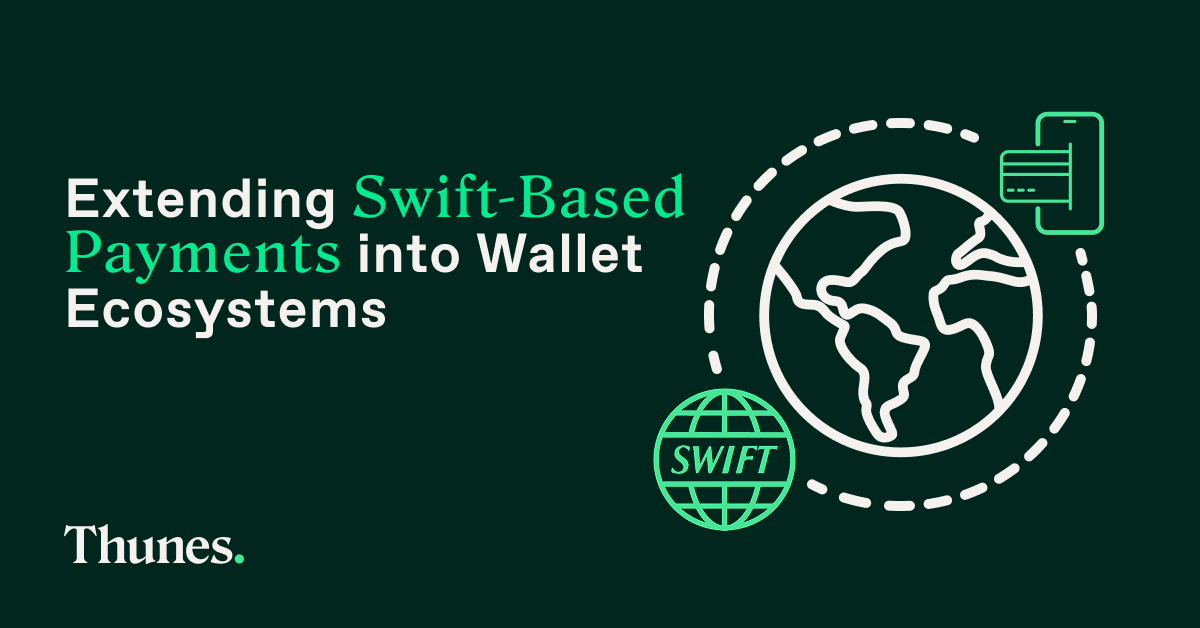
Extending Swift-Based Payments Into Wallet Ecosystems
As the range of methods to money around the world expands, the way Swift supports payments, however and wherever they are made, is changing accordingly.
Across many markets, recipients now rely on digital wallets, real-time payment systems, and digital accounts as primary financial endpoints. This has created a structural gap between established banking rails and the payout methods now used.
The challenge is not rebuilding the system, but extending it. Banks need a way to move from Swift-based origination into wallet-based delivery without adding complexity or fragmenting their infrastructure.
Thunes’s pursuit of interoperability closes that gap.
The next phase of cross-border payments depends on how effectively institutions can connect traditional banking rails with modern payout ecosystems.
Table of contents
Swift remains the foundation, but endpoints have changed
Swift messaging still underpins cross-border banking, connecting more than 11,500 financial institutions across over 200 countries and territories, and continues to evolve through initiatives such as ISO 20022, which improves the richness and standardisation of payment messaging across cross-border networks.
Banks and financial institutions still rely on this established correspondent banking infrastructure to originate and coordinate international payments across global markets.
That foundation has not changed. What has evolved is the diversity of payout environments that those payments now need to support.

Cross-border transactions increasingly terminate outside traditional banking rails, particularly in markets where mobile-first financial adoption has outpaced bank account penetration.
Wallet ecosystems – both mobile and stablecoin-focused – domestic instant payment systems, and alternative digital endpoints now play a larger role in how consumers and businesses receive funds.
This shift is reshaping payout expectations across several areas:
- Consumers expect faster access to funds through digital wallets
- PSPs and remittance providers need access to multiple payout methods across different markets
- Businesses require broader reach into regions where wallets are part of everyday commerce
- Banks face growing pressure to support local payout preferences without rebuilding existing infrastructure
The result is a payments environment where origination remains bank-led, while delivery becomes increasingly fragmented across local systems and digital endpoints.
The growing gap between bank rails and wallet delivery
The rise of wallet-first economies and local digital payment systems has expanded payout possibilities for banks and PSPs.
It has also introduced new operational complexity.
Swift infrastructure was designed to support communication among financial institutions, while wallets and instant payment systems operate on separate networks and through different providers. Reaching those endpoints, therefore, requires additional connectivity beyond traditional correspondent banking rails.
For banks and PSPs expanding across multiple markets, this creates fragmentation at both the technical and operational level. Different corridors may require separate wallet integrations, local compliance processes, varying settlement models, and market-specific reconciliation workflows.
Managing these requirements individually increases operational overhead and limits scalability, particularly for institutions trying to support multiple payout types across global markets.
The challenge is no longer limited to moving funds between banks. It is ensuring payments that originate within established banking infrastructure can continue seamlessly into the digital payout systems now used by recipients worldwide.
This is where interoperability becomes operationally critical.
Enter interoperability, the critical layer
Interoperability is what allows diverse payment systems across the globe to operate together within a connected cross-border payment flow.
This is a question of extending infrastructure into new payout environments.
The growth of wallets and alternative payout methods doesn’t reduce the importance of established banking infrastructure. Cross-border payments still originate through banks, correspondent relationships, and Swift-based messaging networks.
What institutions need is a way to extend that infrastructure into the payout methods now used across recipient markets.
For banks and PSPs, replacing existing systems is neither practical nor necessary. The priority is creating continuity between traditional banking rails and the expanding range of digital payout environments now shaping international money movement.
Creating a continuous payment flow
Interoperability enables payments to move across different systems without creating fragmented operational processes for every corridor or payout type.
A payment may originate via Swift-connected banking infrastructure while the recipient receives funds through a digital wallet, local account, or another digital endpoint. Rather than operating as separate stages, interoperability allows those systems to function as part of a continuous payment flow from origination to delivery.
This gives institutions the ability to support broader payout reach while maintaining operational consistency across multiple markets and payment methods.
How Thunes extends Swift into wallet ecosystems
Interoperability becomes practical only when institutions can extend existing banking connectivity to the payout systems used across recipient markets.
This is where Thunes operates as a connectivity layer.
Using existing Swift connectivity to expand payout reach

For many banks and PSPs, Swift connectivity already serves as the starting point for international payment origination. Thunes extends that reach through its Direct Global Network, enabling payments initiated via traditional banking infrastructure to flow into wallet ecosystems and local payout systems worldwide.
Instead of requiring banks and PSPs to build separate integrations for individual wallet providers or local payout systems, Thunes enables institutions to extend existing payment flows into wallets, accounts, and digital endpoints through a unified network model.
Supporting wallets, accounts, and digital endpoints through one connection
Through Thunes’ Direct Global Network, institutions can support multiple payout methods across global markets through a single integration.
This includes:
- Pay-to-Mobile-Wallets capabilities across mobile wallet ecosystems
- Pay-to-Banks delivery through local and international banking networks
- Pay-to-Stablecoin-Wallets supports new forms of digital value transfer
For banks and PSPs, this expands their reach into wallet-first markets while reducing the operational overhead of managing multiple payout infrastructures independently.
The result is broader global payout capability combined with greater operational consistency across payment types, corridors, and recipient endpoints.
Built-in FX management and compliance
Thunes supports this connectivity model through infrastructure designed to manage liquidity, routing, compliance, and payment visibility across cross-border flows.
The SmartX Treasury System helps coordinate transaction routing and liquidity management across multiple payout environments, while the Fortress Compliance Platform supports oversight, control, and traceability across payment operations.
These systems support cross-border payment delivery across different rails, markets, and payout methods while maintaining operational consistency at scale.
What this unlocks for banks and PSPs
Interoperability changes cross-border payments from a corridor-by-corridor operational challenge into a more unified operational framework.
This creates several practical advantages:
- A single integration model instead of separate builds for individual corridors and payout systems
- Support for multiple payout methods across wallets, bank accounts, and stablecoin-enabled transfers
- Expanded reach into wallet-first and mobile-first markets across emerging economies
- Lower operational complexity while supporting broader global payout capabilities
Payout expectations will continue to diversify across global markets. That makes the ability to connect established banking infrastructure with modern digital payment systems an increasingly important part of cross-border payment strategy.
Interoperability is defining cross-border payments
Swift remains central to global cross-border banking infrastructure. International payments still originate through banks, correspondent relationships, and established messaging systems that continue to support global financial connectivity at scale.
What has changed is the diversity of payout environments that those payments now need to reach. Digital wallets, real-time payment systems, and digital endpoints are becoming part of everyday financial activity across many markets, creating new expectations around payout flexibility and reach.
The future of cross-border payments will be defined by interoperability between systems already moving money globally and the digital payout environments that shape how recipients access funds today.
Get in touch to explore how Thunes extends Swift-based payment origination into wallets, accounts, and digital endpoints across global markets.