How PSPs Can Reduce Integration Complexity Through Interoperability
Expanding payout coverage should create opportunities for Payment Service Providers (PSPs).
But for a PSP that already has strong payout coverage across its home region, expansion beyond that footprint can create a new challenge. To compete for enterprise clients against global PSPs with broader existing reach, regional providers may need to add new markets, corridors and payment methods. If each one requires another connection to build and maintain, how do you extend coverage without letting the technology behind it become difficult to manage?
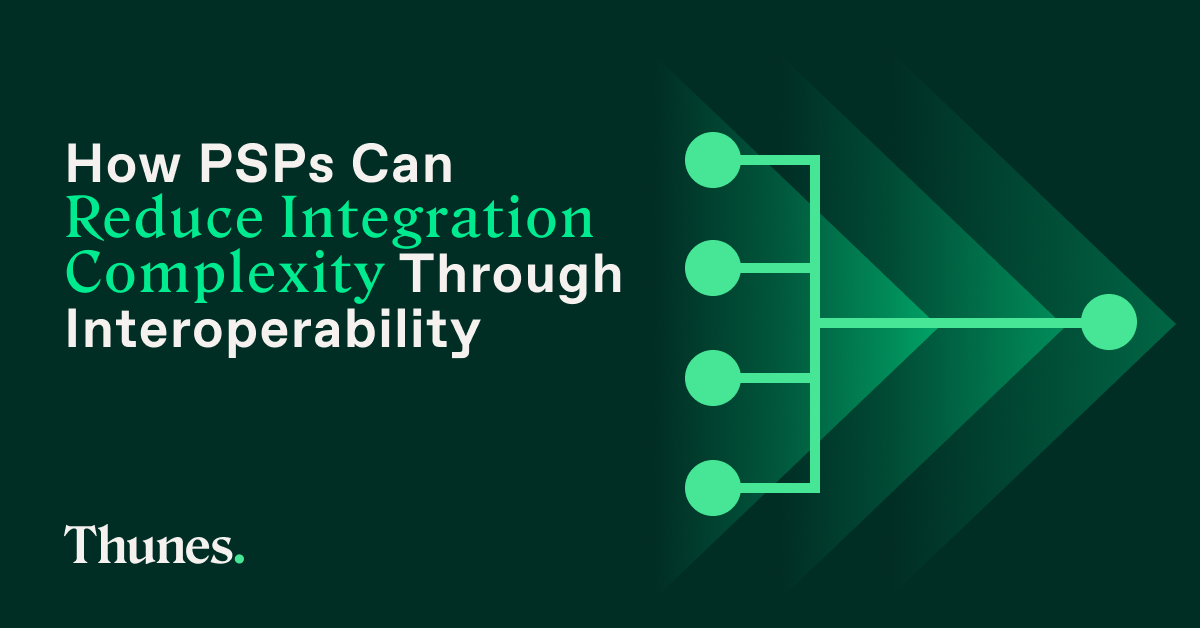
Interoperability offers a way to expand payout coverage without requiring the integration footprint to grow at the same rate.
In this article, we look at how PSPs can use interoperable payment networks like Thunes to expand payout coverage while keeping integration complexity under control.
Table of contents
- Expanding beyond an existing payout network creates a new integration challenge
- Building payout coverage market-by-market creates a growing integration footprint
- Interoperability changes how PSPs connect to local payment systems
- A single network connection can separate payout growth from integration growth
Expanding beyond an existing payout network creates a new integration challenge
Many Payment Service Providers already have strong payment infrastructure in the markets they know best. A regional PSP might have established connections to banks, wallets and local payment systems across its home market or region.
The challenge appears when its customers need it to go further.
An enterprise client entering new countries might ask the PSP to support additional currencies, corridors and payout methods. The PSP then has a choice: build the required connections itself, establish new local partnerships, or extend its reach through a broader payment network.
As we covered in our article on building infrastructure for the payout economy, geographical coverage alone is not enough. PSPs also need sufficient depth within each corridor. Being able to send money into a country is not the same as supporting the payment ecosystem within it.
Payment behaviour across individual markets shows why:
- Brazil: Digital payment methods like Pix have become deeply embedded in the market, making access to locally preferred digital options an important part of meaningful payment coverage.
- Spain: Instant account-to-account payments have become part of everyday payment behaviour, with domestic services such as Bizum giving consumers a widely adopted way to send and receive money.
- South Korea: Near-universal access to bank accounts sits alongside extensive card use and widespread mobile financial services, creating a mature payment ecosystem with several established ways to pay.
- South Africa: Banks remain central to the payment system, while newer infrastructure such as PayShap is expanding access to instant account-to-account payments.
For a PSP extending beyond the markets where it already has established connections, each new destination can introduce a different combination of technical and operational requirements.
Adding a payout method also isn’t necessarily a one-time technical project. APIs change, payment methods evolve, and connections need to be monitored and maintained. The more individual systems a PSP connects to directly, the more technical and operational dependencies its teams may have to manage.
Building payout coverage market-by-market creates a growing integration footprint
If a PSP chooses to extend its payout network by building direct connections in each new market, every expansion can bring another set of relationships and technical requirements to manage.
The complexity grows because payment systems have largely developed within their own domestic and regional environments. A connection that works for one market cannot necessarily be replicated in the next.
For every new market or payment partner, PSPs may need to account for differences in:
- APIs and connection protocols
- Payment messaging and data formats
- Beneficiary information requirements
- Payment status and confirmation processes
- FX and settlement arrangements
- Reconciliation and reporting
- Compliance requirements
- Availability of local payout methods
Connecting to these systems individually can leave PSPs managing a growing web of separate integrations, which might look as follows:
PSP → Bank partner A
PSP → Mobile wallet provider B
PSP → Local payment rail C
PSP → Bank partner D
PSP → Wallet provider E
PSP → Stablecoin wallet provider F
Replicate that model across multiple markets and the integration burden can grow quickly.
For a PSP deciding whether to build its way into each new market, this is the trade-off: greater direct control over individual connections, but a larger integration footprint to develop, monitor and maintain.
Adding another destination can mean adding another set of technical dependencies behind it, making the relationship between geographic growth and integration work increasingly difficult to separate.
Interoperability changes how PSPs connect to local payment systems
Interoperability offers a different model.
Instead of connecting separately to every bank, wallet or local payment rail, PSPs can connect to a network that already links those systems together.
For a regional PSP expanding beyond its existing footprint, that creates an alternative to building every new connection directly. It can retain the infrastructure and relationships that already serve its core markets, while using an interoperable network to reach destinations where it does not yet have local connectivity.
Market-by-market integration
Under a market-by-market model, the PSP establishes individual connections to the payment systems and providers it needs to reach. As the PSP enters more markets and adds more payout methods, those connections accumulate.
PSP → Multiple individual integrations → Banks | Wallets | Cards | Local payment rails → Individual markets
It means that expansion becomes constrained by the integration work required in each destination.
Interoperable integration
An interoperable model places a common connection between the PSP and those underlying payment systems. Much of the underlying work required to connect these different payment environments can happen behind the network connection.
For the PSP, and ultimately its customers and recipients, that complexity can remain largely out of view while payments still reach the appropriate local destination and in the preferred format.
PSP → Common connection → Interoperable network → Banks | Wallets | Cards | Local payment rails → Multiple markets
That can change how much integration work sits behind expansion:
- Fewer individual connections to develop and maintain
- A more consistent technical interface across markets
- Easier addition of new payout destinations
- More standardised payment information and reporting
- Less dependence on maintaining separate relationships with every downstream provider
- Less treasury complexity, with Thunes managing FX and liquidity across the network rather than the PSP having to balance funds across individual markets and payment relationships
It’s important to establish that interoperability doesn’t remove the differences between local payment systems. It reduces how much of that fragmentation the PSP needs to manage directly.
A single network connection can separate payout growth from integration growth
For PSPs, the practical value of interoperability is that adding a new market or payout method doesn’t need to trigger another major integration project.
Thunes’ Direct Global Network is one example of this model. Through a single API integration, PSPs can reduce some of the technical and operational work involved in expanding their cross-border payment capabilities:
- Access 220 payment methods across 140 markets. PSPs can reach mobile wallets, stablecoin wallets, bank accounts and cards across emerging and developed markets without recreating that breadth connection by connection.
- Get to market faster. New payout capabilities and corridors can be added through the existing integration rather than requiring another market-by-market integration cycle.
- Manage liquidity more flexibly. PSPs can use traditional fiat pre-funding or fund Thunes 24/7/365 using USDC and EURC, while supporting payouts in both fiat and stablecoins.
- Manage FX across 90 currencies. SmartX Treasury provides transparent pricing, real-time FX optimisation and tools for managing liquidity across currencies.
- Support compliance across markets. Fortress Compliance combines 50 licences with embedded risk controls to support adherence to local regulatory requirements.
- Get support beyond implementation. Thunes works with PSPs through integration and go-live, followed by ongoing monitoring, issue resolution and support as they add markets and corridors.
Thunes manages the underlying connections to local payment systems and partners across its network, allowing PSPs to add corridors as their coverage requirements change without having to build every connection themselves.
That gives PSPs a choice in how they expand. Direct integrations can still make sense in markets where the PSP wants to maintain its own local connectivity, while an interoperable network can extend coverage into markets where building those connections directly would add more integration work.
For PSPs competing for enterprise clients, that distinction matters. If every new corridor or payout method requires another major integration project, infrastructure can become a constraint on expansion and on how quickly the PSP can respond to client demand. That creates a real competitive risk. Enterprise clients may turn to larger global PSPs that can already offer the markets, payment methods and payout capabilities they need.
Interoperability gives PSPs another model: extend payout coverage as demand changes, without having to expand their integration footprint at the same rate.
Contact Thunes to learn more about connecting to the Direct Global Network, or download the PSP playbook for a deeper look at building payout capabilities across markets.