Leading Digital Asset Adoption in Payments
Stablecoins have transformed in the space of a few short years, from a poorly understood crypto tool to a regulated, highly watched and rapidly expanding family of payment solutions.
Thunes has supported this evolution from the start, and has firmly embraced stablecoins as a fundamental part of our Direct Global Network, bridging digital and fiat payments across borders.
- Stablecoins enter the mainstream
- Solving liquidity problems with just-in-time stablecoin prefunding
- Solving access issues by bridging digital and fiat during global payouts
- The strategic imperative for PSPs
- A future-proofed payments ecosystem
Stablecoins enter the mainstream
For Payment Service Providers (PSPs) and global platforms, the conversation has moved beyond the question of whether digital assets have a role in the global economy. The new reality is about how these assets integrate into existing, regulated payment architectures to solve long-standing inefficiencies that have hampered cross-border commerce for decades.
At Thunes, we have been at the forefront of this shift towards stablecoins as a critical tool for driving liquidity, speed, availability and reliability. By integrating stablecoin capabilities directly into our Direct Global Network, we are providing the last mile connectivity that businesses require to move funds instantly – bypassing the traditional limitations of bank operating hours and fragmented, multi-step clearing processes.
Solving liquidity problems with just-in-time stablecoin prefunding
The cross-border payment landscape is defined by complexity. Transfers often involve a patchwork of correspondent banks, manual compliance checks, and idle, pre-funded ‘nostro’ accounts.
Legacy processes mean these payments can take two to five days to settle, with fees averaging around 6% for many remittances – a common use case for stablecoin payments today.
In our recent report, Stablecoins and the Future of FX: A New Era of Liquidity, co-authored with Circle, we assess industry analysis estimating the $10 trillion global opportunity represented by pre-funding trapped in accounts, acting as a massive liquidity drain on the legacy financial system. For high-growth PSPs, the cost of this trapped liquidity is a constant pressure on margins and operational agility.
Stablecoins represent a fundamental shift from these traditional banking models. Instead of relying on fragmented infrastructures, they use open liquidity pools on blockchain networks that are accessible 24/7. By leveraging regulated, fiat-backed stablecoins – such as USDC – businesses can transition from a ‘pre-fund and wait’ model to ‘just-in-time’ liquidity.
This shift allows treasury teams to reallocate capital instantly, reducing the need for trapped liquidity in high-cost corridors and improving cash availability in the process. In some use cases, stablecoin settlements can bring that fee down from the typical averages of 6% noted above to below 0.2%.
While solving the prefunding challenge addresses the liquidity drain, the true challenge for PSPs is the second component of cross-border commerce: ensuring seamless access and bridging that digital liquidity to the recipient’s local payment system.
Solving access issues by bridging digital and fiat during global payouts
The true challenge for PSPs is not just the ability to hold or move digital assets; it is the ability to bridge the gap between blockchain-based liquidity and the local fiat systems where recipients live and work.
Thunes has solved this by embedding stablecoin liquidity directly into our Direct Global Network to deliver global payout capabilities. From our early adoption of the technology to our recent strategic progress, Thunes demonstrates our commitment to this infrastructure:
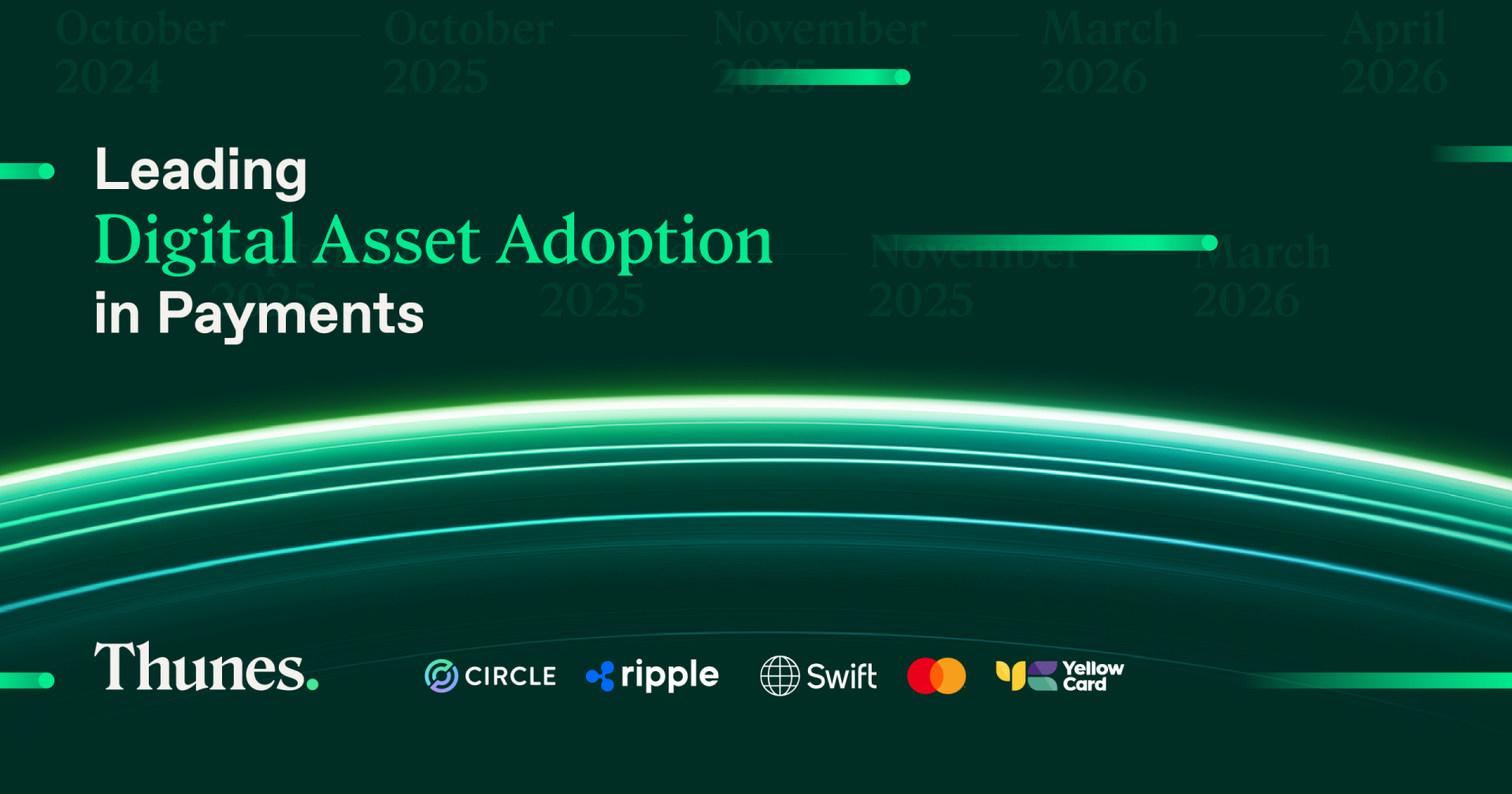
- October 2024: Established a partnership with Circle to enhance global liquidity.
- September 2025: Welcomed Ripple to our Direct Global Network.
- October 2025: Launched our Pay-to-Stablecoin-Wallets solution and integrated Yellow Card into our network.
- November 2025: Mastercard to deploy Thunes Pay-to-Stablecoin wallet solution.
- November 2025: Thunes launched an on- and off-ramp solution for Digital Asset companies.
- March 2026: Enabled Pay-to-stablecoin-wallets via SWIFT and released our joint white paper with Circle: A New Era of Liquidity.
- April 2026: Joined Circle Payments Network Managed Payments, to advance global payment interoperability.
These milestones represent our steps in building a seamless, interoperable layer that connects the new world of digital assets with the mature, regulated world of banks and mobile wallets.
By joining digital assets to our Direct Global Network to 11,500 banks via Swift messaging and a vast array of mobile and stablecoin wallets, we ensure that stablecoin liquidity is not an isolated silo, but a gateway to global payout capabilities.

The strategic imperative for PSPs
As stablecoins become a standard instrument for high-volume, cross-border treasury flows and B2B settlements, the advantage lies with the networks that can offer a single point of integration.
Thunes provides a single point of integration for PSPs, eliminating the need to build bespoke bridges for every new digital asset or local payout corridor.
Our comprehensive Digital Assets strategy is built on three core capabilities:
- We have integrated stablecoins into our Direct Global Network for more efficient liquidity management.
- We serve Digital Asset companies with on and off ramp capabilities.
- We allow the Members of our Direct Global Network to pay out beneficiaries into USDC and USDT to Stablecoin wallets.
This strategic foundation, in turn, delivers three vital pillars of advantage that define the new era of digital liquidity for our members:
- Treasury efficiency: By maintaining a single USDC balance, businesses can consolidate funds, enabling real-time funding and simplified reconciliation without the need to manage multiple, high-cost foreign currency accounts.
- Operational agility: Businesses can quickly adjust fund flows in response to market needs, rather than being bound by the delays of traditional banking cut-offs or holiday closures.
- Embedded compliance: Through our Fortress Compliance Platform, we ensure that every transaction – whether fiat or stablecoin – meets rigorous regulatory standards, linking blockchain transactions to traditional financial systems for better visibility and auditability.
A future-proofed payments ecosystem
The integration of stablecoins is rapidly reshaping the FX landscape. As trading moves increasingly onto blockchain platforms, FX is shifting toward continuous, decentralised currency exchange. This eliminates the need for traditional trading hours and drastically reduces settlement risk.
While central banks continue to explore Central Bank Digital Currencies (CBDCs), regulated stablecoins are expected to continue leading the way in retail and cross-border innovation.
A future where stablecoins and CBDCs coexist and interoperate seamlessly is increasingly likely. For PSPs, this means the infrastructure they choose today must be flexible enough to handle this evolution – and indeed whatever other innovations may occur worldwide.
Thunes is doing just that: building for the future through the infrastructure that global businesses need today, and to solve fragmentation and scale their operations tomorrow.
Are you ready to optimise your treasury operations? Explore our stablecoin liquidity solutions or contact our team to discuss how we can integrate digital asset liquidity into your payment corridors.