Rethinking Liquidity Management in Cross-Border Payments

Cross-border payments depend on liquidity being in the right place at the right time. In order to ensure payments can be completed without delay, that has traditionally meant banks hold capital across multiple accounts, currencies, and markets.
The problem is that distributing liquidity across corridors ties up capital, limits flexibility, and creates complexity with every new market added. Fragmented balances are hard to reposition, and prefunded accounts in low-volume corridors sit idle while demand spikes elsewhere.
New liquidity models are changing how this works. Stablecoins and network-based solutions allow funds to be deployed more dynamically, reducing the need to hold capital across multiple locations and enabling a more centralised approach to liquidity management.
This article looks at how that shift is playing out, and what it means for banks and payment providers managing cross-border flows at scale.
Table of contents
- Why liquidity management is still a constraint in cross-border payments
- The limits of prefunding and corridor-based liquidity
- The shift toward more dynamic liquidity models
- The role of stablecoins in treasury and settlement
- Combining with network-based treasury layers
- From fragmented liquidity to unified control
Why liquidity management is still a constraint in cross-border payments
Banks managing cross-border flows carry a structural overhead that many other financial operations do not.
Every corridor requires management of its own settlement timing, local clearing access, and currency availability. Treasury teams cannot wait for demand to materialise; they need coverage in place across multiple markets simultaneously, regardless of whether volumes justify it.
- Funds are held across multiple nostro accounts in different jurisdictions
- Prefunded balances are maintained with correspondent banks and local partners
- Liquidity is positioned in advance to meet settlement windows and payout requirements
- Coverage is required across time zones, regardless of when payments are initiated
Capital must sit in multiple locations to support activity across corridors, even if volumes are uneven.
The result is treasury operations that are always playing catch-up, managing a set of fixed positions against a payment landscape that does not stay fixed.
The limits of prefunding and corridor-based liquidity

As a functional cross-border payment procedure, prefunding works. It ensures funds are available in the right location at the right time, and it has been the default approach for supporting cross-border payments for many years. The problem is that it scales badly.
Liquidity is tied to individual corridors
In a prefunded model, each payment corridor requires its own allocation of capital. Funds are positioned in advance based on expected volumes, creating a system where liquidity is distributed across markets rather than managed centrally.
The drawback is that capital is committed before it is needed and remains tied to specific routes regardless of actual demand.
Treasury operations scale with complexity
Managing these positions introduces ongoing operational work that increases with scale. Treasury teams need to monitor balances and accounts, and coordinate across multiple providers, each with its own settlement processes and timing requirements.
Differences in cut-off times and processing cycles add another layer of coordination, particularly when managing flows across regions.
Expansion requires additional capital, not just connectivity
Growth is not only a question of accessing new payout rails. It also requires additional capital to support them.
Entering a new corridor increases the number of accounts, partners, and liquidity positions that need to be maintained – and each new position requires capital to be committed in advance.
Research from the Bank for International Settlements has consistently highlighted the liquidity costs embedded in correspondent banking models, noting that pre-funded nostro balances represent a significant and largely unproductive use of capital across the banking system.
For banks managing multiple corridors, each additional currency or market served adds to a balance sheet overhead, which scale does not reduce.
As more corridors are added, liquidity becomes further fragmented, and the effort required to manage it increases alongside transaction volumes.
Liquidity is managed locally, not globally
The combined effect is a model where liquidity is managed as a series of local positions. Capital is constrained by where it is held, rather than being available as a single pool that can be deployed where needed.
That limits how efficiently liquidity can be used and makes it harder to scale without adding operational overhead.
The shift toward more dynamic liquidity models
At the same time, payment expectations have changed across the financial systems we all use. Faster settlement, extended availability, and growing cross-border volumes are putting pressure on treasury models that rely on static, pre-positioned liquidity – and the evidence of that pressure is visible in both volume growth and in how the industry is responding.
Cross-border payment flows are expanding across all major corridors, with particularly strong growth in Asia-Pacific, sub-Saharan Africa, and Latin America – precisely the markets where traditional correspondent banking infrastructure is thinnest and prefunding costs are highest.
At the same time, research from the Centre for Economics and Business Research indicates that more dynamic settlement approaches – including stablecoin-based instruments – can improve cash availability by three to six days, a material operational advantage for treasury teams managing tight rebalancing windows.
Banks need to respond to demand as it happens, rather than relying solely on forecasts and pre-funded balances. That requirement is driving a fundamental shift in how liquidity is structured and deployed.
From static balances to deployable liquidity
Traditional models depend on funds being held in specific locations ahead of time. Newer approaches focus on making liquidity available when and where it is needed – ‘always on’ – without requiring it to sit idle across multiple accounts.
With a more flexible operating model, liquidity can be repositioned closer to the point of demand, based on real-time requirements rather than static forecasts.
And as payment systems move toward extended hours or continuous operation,treasury teams need to support flows that don’t align with standard banking cut-offs.
Dynamic liquidity models allow funds to move across systems and counterparties with fewer timing constraints, helping maintain coverage without increasing the number of prefunded positions.
The role of stablecoins in treasury and settlement
Stablecoins are increasingly present in discussions about cross-border liquidity, but their practical role for banks is at present quite specific.
For treasury and settlement purposes, the relevant question is under what regulatory conditions a bank can rely on them operationally. That question is still being answered in most jurisdictions.
In the UK, the FCA is developing its regulatory approach to stablecoins used in systemic payment systems under powers established by the Financial Services and Markets Act 2022.
In the EU, the Markets in Crypto-Assets Regulation (MiCA) introduced an e-money token framework in 2024, but implementation continues to evolve across member states. Across many of the corridors most relevant to remittance-based cross-border flows – sub-Saharan Africa, South and Southeast Asia, parts of Latin America – the regulatory treatment of stablecoin settlement remains jurisdiction-specific and in some cases actively restricted.
Where stablecoins offer immediate value
Within the corridors and contexts where regulatory conditions support it, stablecoins offer an important solution to the timing and fragmentation challenges of liquidity rebalancing across correspondent relationships.
Traditional rebalancing depends on banking cut-off times and batch-based settlement cycles. Stablecoin transfers, by contrast, can move value between entities or markets outside those windows, with settlement confirmed on-chain and an auditable transaction record available throughout.
For treasury teams managing positions across time zones, that speed and transparency has direct operational value:
- Rebalancing between accounts and counterparties without relying on standard correspondent banking cut-off times or batch-based processing cycles
- Reduced reliance on idle buffers maintained solely to cover timing gaps
- Greater flexibility in responding to unforecast shifts in payment volumes
Bridging between digital and local payment systems
To complete a payment with an end-point payout, stablecoins must convert cleanly into local fiat and reach domestic payout rails. This means that the stablecoin liquidity movement mechanism and the last-mile delivery through established payment infrastructure must work effectively together.
Doing so extends the range of options available to treasury teams – particularly for rebalancing and for corridors where currency volatility makes fiat-only solutions less effective. They provide a way to move liquidity across borders with fewer timing constraints, while still relying on established payment systems for final delivery.
Combining with network-based treasury layers
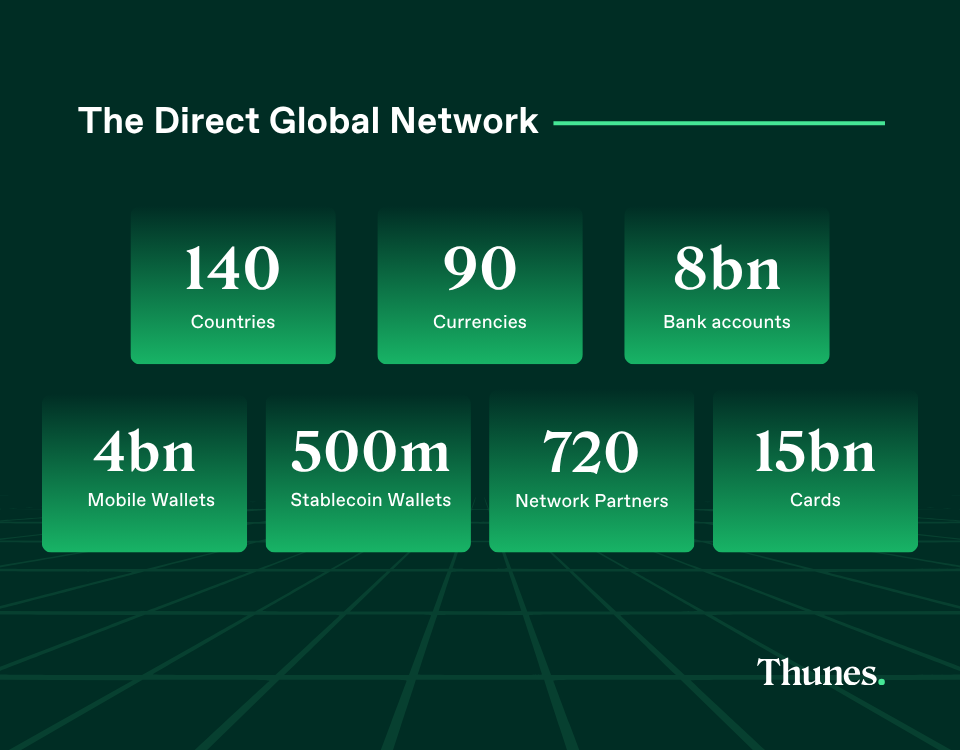
Traditionally, accessing new payout routes requires separate integrations, local partners, and dedicated liquidity. Network-based models like Thunes simplify this by aggregating access through one connection.
Treasury and payments teams can access mobile wallets, stablecoin wallets, bank accounts, cards and other local payout methods through a single integration, with built-in, real-time compliance.
Interoperability across payment systems
Interoperability is what makes this model work in practice. A bank that connects once and reaches multiple rails, currencies, and payout types across markets is not just a matter of access; it reflects how those systems interact.
Through an interoperable network, different payment systems can be accessed without requiring separate infrastructure or operational models for each market. For treasury teams, this means liquidity can be applied across systems without needing to be structured differently for each one.
Liquidity managed centrally, not per corridor
With access consolidated at the network level, liquidity no longer needs to be segmented in the same way. Instead of maintaining prefunded balances for each route, funds can be managed more centrally and deployed based on actual payout requirements.
This reduces the need to hold capital across multiple locations and allows treasury teams to treat liquidity as a shared resource rather than a set of fixed positions.
Thunes’ SmartX Treasury System
Thunes’ SmartX Treasury System brings these elements together within a single network layer.
Through one integration into Thunes’ Direct Global Network, banks can access a wide range of payout options across global markets, without managing multiple local connections or prefunded accounts.
Thunes’ Direct Global Network currently connects 720 Members across 140 countries, supporting payments across 90 currencies and more than 220 payment methods – including mobile wallets, stablecoin wallets, bank accounts, and cards. 85% of payments through the Network settle immediately, with a 98% quality-of-service success rate across corridors.
Rather than maintaining prefunded balances in each target currency, banks fund a single central position – either in fiat or in stablecoins – and SmartX Treasury manages the deployment of that liquidity to payout rails at the point of payment.
Settlement optionality
SmartX Treasury supports both fiat-based and stablecoin-based funding models, allowing banks to determine which approach suits their regulatory position and operational requirements by corridor.
Currency conversion occurs at the final payout stage rather than at the point of funding, which gives treasury teams more precise control over FX timing and rate exposure. The result is that liquidity is held centrally and deployed on demand, rather than being distributed across corridors in advance.
Where stablecoin-based pre-funding is used, settlement occurs on the blockchain network, while last-mile delivery to local payout endpoints is handled through Thunes’ Network.
From a treasury perspective, this enables:
- A unified approach to accessing global payout rails
- Support for both fiat-based and stablecoin-based settlement models
- The ability to deploy a single liquidity pool across different corridors and payout types
This structure allows liquidity to be managed centrally and applied where it is needed, rather than being distributed across multiple accounts in advance.
Compliance infrastructure
For banks evaluating any cross-border network, regulatory reporting and compliance obligations are not secondary considerations. Thunes’ Fortress Compliance Platform operates alongside the SmartX Treasury System, providing KYC/AML monitoring across Network Members, automated transaction reviews, and end-to-end data records that link blockchain transactions to traditional financial systems for audit purposes.
This infrastructure is designed to supplement a bank’s own compliance and reporting obligations rather than replace them. Thunes conducts its own due diligence on an ongoing basis, but banks retain responsibility for their own regulatory reporting requirements in the jurisdictions they operate in.
From fragmented liquidity to unified control
Liquidity in cross-border payments has historically been distributed across corridors, accounts, and counterparties. That structure ensured coverage, but it limited how efficiently capital could be used; this is now changing.
Stablecoins are changing how value moves. Network-based layers are changing how that value reaches payout systems. Combined, they allow liquidity to be managed more centrally and deployed based on demand, rather than being fixed in place ahead of time.
For banks, the operational shift is from managing liquidity as a set of local positions to deploying it as a single pool across global corridors.
The result is a treasury function where capital is maximised, and scaling is no longer constrained by complexity.
Speak to one of our experts about how to integrate fiat and stablecoin solutions in your organisation.