Spain has set the standard for instant payments. Global interoperability is next
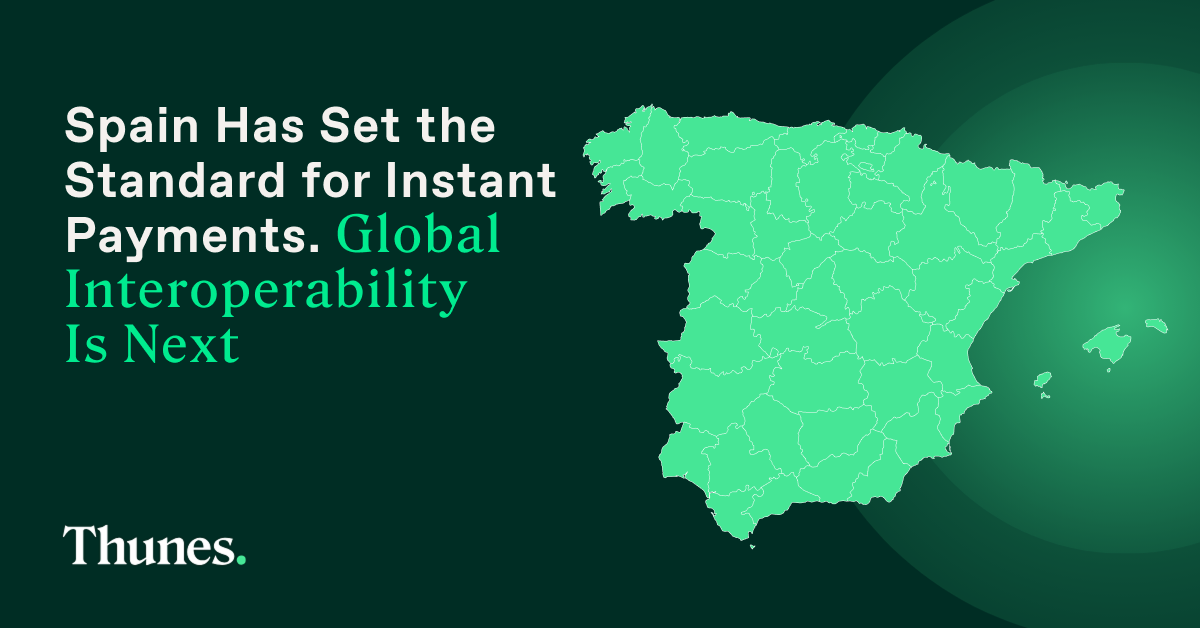
Spain has become one of Europe’s leading instant-payment markets, setting a new standard for how consumers and businesses expect money to move.
The next challenge is extending that experience beyond national borders. While Europe is making important progress towards greater interoperability, delivering the same speed, transparency and reliability globally remains far more complex.
This article explores how Spain’s payment ecosystem is evolving, why interoperability is becoming critical for cross-border payments, and how Thunes helps financial institutions deliver modern payment experiences across global markets.
Table of contents
Spain is one of Europe’s leading instant-payment markets
Over the past decade, real-time account-to-account payments have become part of everyday life in Spain, supported by widespread bank participation, strong digital adoption and continued investment in payment infrastructure.
- Spain adopted the EUR as its official currency on the 1st Jan 1999
- The country joined the Single Euro Payments Area (SEPA) from its inception, as SEPA was designed for Eurozone countries. SEPA credit transfers launched in January 2008, and Spain fully migrated its national payments to the mandatory SEPA standards by February 2014. As a founding euro area member, Spain was part of the core rollout
At the centre of this transformation is Bizum. Since launching in 2016, the bank-backed payment solution has grown to more than 30 million users across Spain and Andorra, demonstrating how quickly bank-led, mobile-first account-to-account payments can become part of everyday life.
Spain’s payment ecosystem has continued to evolve through:
- SEPA Instant Credit Transfer, enabling euro payments to settle within seconds
- Iberpay, which operates Spain’s instant-payment infrastructure and processes the transfers underpinning Bizum
- The EU Instant Payments Regulation, accelerating the availability of instant euro transfers across member states
For Spanish consumers and businesses, speed and availability are increasingly baseline expectations rather than premium features.
For banks, PSPs and businesses, this has increased expectations around how payments should perform.
Spain is already connecting outward
The next stage is to make the same payment experience possible across borders, beginning with closer interoperability among European payment systems.
Recent developments are reflecting a broader shift towards greater interoperability across Europe:
- The European Payments Alliance (EuroPA) is cooperating with the European Payments Initiative (EPI) to connect domestic mobile payment solutions, allowing users in participating countries to send and receive instant payments across borders. Bizum has already begun interoperating with payment solutions in Italy and Portugal
- Iberpay is extending instant payments beyond the SEPA area through its One-Leg-Out Instant Credit Transfer service
- BBVA’s Directa service uses this infrastructure to support faster inbound international payments into Spain, while BBVA also became one of the first participants in Swift’s new global retail payments scheme when it launched in July 2026
Beyond Europe, however, the challenge becomes significantly more complex.
Businesses expanding globally still need to navigate different payment systems, currencies, compliance and regulatory requirements and recipient preferences across every market they serve.
Why global interoperability remains the operational challenge
Scaling payment experiences globally introduces a new set of operational challenges.
Every market works differently
Recipient expectations vary from one market to the next. In some countries, bank accounts remain the preferred destination. In others, mobile wallets, domestic real-time payment systems or card-based payouts are the standard way to receive funds.
Supporting these local preferences often requires organisations to:
- Connect to multiple payment systems and build relationships with financial institutions
- Support different payout methods based on recipient preferences
- Navigate varying regulatory and compliance requirements
- Manage currencies and foreign exchange risk
- Hold liquidity across different markets
The challenge is no longer simply moving money across borders. It is connecting seamlessly with the diverse payment ecosystems recipients rely on around the world.
Global payments require more than faster settlement
Every new market has its own payment ecosystem, and connecting to those ecosystems requires far more than faster settlement.
For example, a payment pathway might look as follows:
Within Europe: Spain (SEPA) → EuroPA → Portugal (MB WAY)
Beyond Europe: Spain → Correspondent banking → FX conversion → Compliance screening → Local banking partner → Pix / UPI / Mobile Wallet → Recipient
For financial institutions and payment providers, expanding internationally means integrating with multiple local payment systems, establishing banking relationships, meeting different regulatory requirements and managing liquidity across markets. As each new destination is added, the operational complexity grows.
Success increasingly depends on interoperability: the ability to connect different payment systems, move funds seamlessly between them and deliver payments through the methods recipients already use and trust.
Why domestic payment success creates new expectations for cross-border payments
As instant payments become the domestic standard, expectations naturally begin to extend beyond national payment systems.
Consumers and businesses increasingly expect international payments to offer the same speed, visibility and reliability they experience when sending money within Spain.
Higher expectations are reshaping cross-border payments
This shift affects far more than consumer transfers. Businesses making supplier payments, payroll, marketplace payouts and cross-border disbursements are under growing pressure to move funds quickly while providing greater transparency over when payments will arrive and how they are progressing.
For many organisations, the expectation is now:
- Fast delivery
- 24/7 availability
- Immediate confirmation
- Clear payment status
- A predictable experience
These expectations do not disappear when money moves internationally
Delivering that experience is more complex across borders
Meeting those expectations becomes significantly more complex once money crosses borders. While Spain has built an instant-payment ecosystem that delivers fast, transparent and predictable domestic payments, extending that same experience internationally requires connecting to a far more fragmented landscape.
International payments may pass through multiple financial institutions, currencies, compliance checks and local payment systems before reaching the recipient. While domestic payment infrastructure has become increasingly interoperable, cross-border payments still depend on networks that have developed independently across different markets.
As a result, delivering a consistent payment experience internationally is about more than settlement speed. Financial institutions and payment providers must navigate operational complexity, maintain visibility across different payment systems, and ensure recipients can receive funds through the payment methods they trust and use every day.
How Thunes extends Spain’s payment capabilities globally
That is where Thunes brings it all together, helping banks, PSPs and global businesses connect their existing payment capabilities to local payout infrastructure worldwide through a single global network.
Through a single integration to the Thunes Direct Global Network, financial institutions, PSPs and businesses can extend modern payment experiences beyond domestic and regional payment systems without building and maintaining individual connections in every market.
The network provides access to:
- 140 countries
- 90 currencies
- 4 billion mobile wallets
- 8 billion bank accounts
- 500 million stablecoin wallets
- 15 billion cards
This enables organisations to:
- Extend domestic payment experiences into international markets
- Deliver payments through local payment infrastructure and recipient-preferred payment methods
- Route payments from existing banking infrastructure into local payment systems
- Manage liquidity through one global network rather than multiple country-by-country connections
- Provide local currency conversion, payment transparency and payment-status visibility across cross-border transactions
For Spanish banks, PSPs and global businesses, the opportunity is to make international payments feel more like domestic ones: faster, more transparent and more predictable, while reducing the operational complexity of managing individual corridors.
With the right global infrastructure, Spain’s leadership in instant payments becomes a foundation for international growth rather than a capability confined to the domestic market.
Get in touch to learn how Thunes helps financial institutions, PSPs and businesses extend modern payment experiences across global markets.