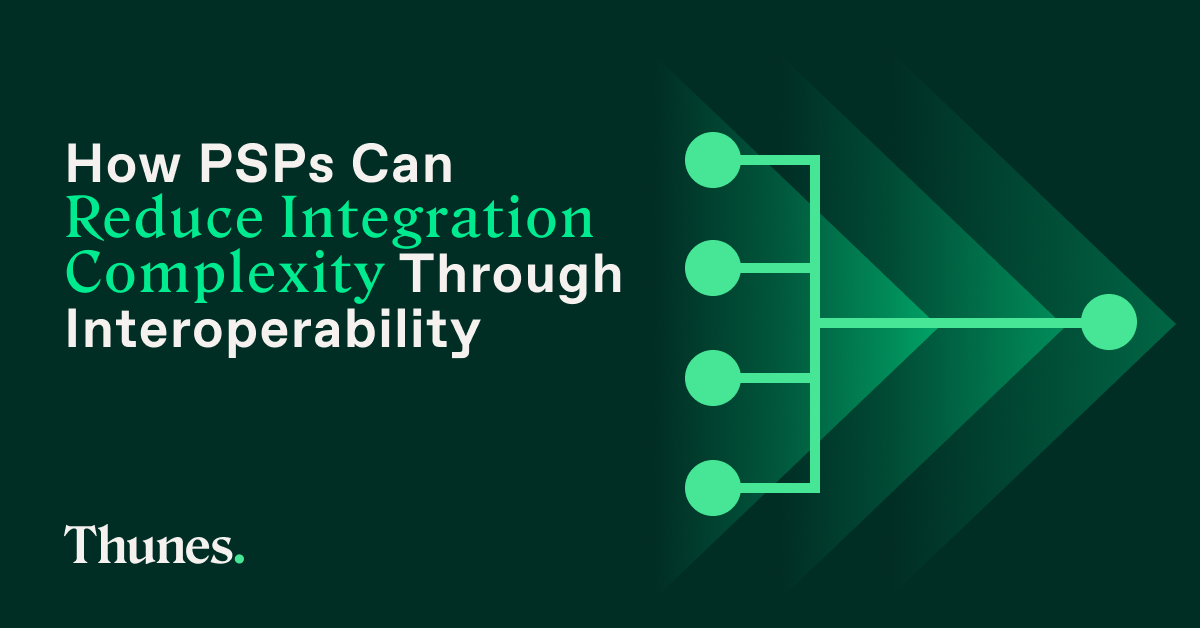
Why interoperability is the real scaling challenge in global payments

Payments today typically move through multiple payment systems, which means cards, mobile wallets, local schemes and newer settlement models have to coexist, often within the same transaction flow.
Most end users never see this complexity, nor care to think about it. To them, a payment experience is either successful or not. Confirmation arrives, funds appear, and the process feels complete. The mechanics behind it are invisible.
That invisibility has to be engineered. As payment choice expands to encompass new and evolving options such as stablecoins and other digital assets, the burden of making that ever-expanding experience consistent falls on PSPs, MTOs and payment platforms, not only at the product layer, but across treasury, compliance and operations too.
Interoperability sits at the centre of that challenge. It’s what Thunes does. As the first of five trends we identified within the next phase of cross-border payments, it’s worth exploring in detail.
Table of Contents
- Scale reveals structural gaps in global payments
- When fragmentation defines the modern payments environment
- How interoperability requires coordination across three layers
- Stablecoins add a shared liquidity layer
- Why sustainable scale depends on interoperable networks
Scale reveals structural gaps in global payments
Cross-border payments are expanding in both volume and complexity, driven by the rise of digital wallets, real-time payment systems and new settlement models. The global cross-border payments market is projected to grow from $397.4 billion in 2026 to $727.7 billion by 2034, reflecting both rising demand and increasing digitisation of financial flows.
With this growth, more people and businesses can now participate in the global economy, with faster and more accessible ways to move money across borders.
At the same time, scale is revealing structural gaps.
As more payment types and rails come online, transactions must pass through a wider set of systems, each with its own processes, timing and requirements. A payment may move instantly within one network, but still depend on available liquidity, compliance checks or settlement processes in another.
These are not failures of the system. They are the natural result of an ecosystem that has developed across markets, use cases and regulatory environments over time. The challenge is to ensure that, as this ecosystem grows, outcomes remain consistent. Speed alone is no longer the differentiator. Predictability is.
Sustainable scale depends on infrastructure that can maintain reliable outcomes even as complexity increases.
When fragmentation defines the modern payments environment
Global payments are built on a diverse set of local systems, each designed to serve specific market needs. This diversity has enabled innovation and inclusion, but it also means that cross-border transactions require coordination across multiple environments.
Mobile wallets illustrate this clearly. Adoption continues to accelerate, with mobile wallets expected to be used by 60% of the world’s population by 2026. However, most wallets operate within domestic or regional ecosystems, limiting cross-border connectivity.
Similarly, domestic real-time payment schemes, bank transfer systems and card networks continue to evolve independently. Each is optimised for local efficiency, meaning cross-border transactions must bridge differences in standards, formats and settlement processes.
Liquidity reflects this same structure. To ensure reliable payouts, businesses often maintain balances across multiple markets and currencies. This approach supports settlement certainty, but also introduces capital and operational considerations as networks expand.
Regulation further shapes the landscape. Licensing frameworks, AML requirements and data policies vary across jurisdictions, requiring institutions to adapt their operations for each corridor.
Taken together, fragmentation is not a flaw. It is a characteristic of a global system built to serve diverse local needs. The challenge lies in coordinating across it.
How interoperability requires coordination across three layers
Interoperability is often associated with connectivity, but at scale, it requires a broader form of alignment.
To support reliable cross-border payments, three layers must work together:
- Technical interoperability: consistent routing, message translation and reconciliation across domestic rails, wallet systems and banking infrastructure
- Liquidity interoperability: the ability to allocate and move capital across currencies and markets without duplicating balances unnecessarily
- Regulatory interoperability: cross-border compliance, traceability and reporting that can operate seamlessly across jurisdictions
Each layer plays a distinct role, but their effectiveness depends on how well they are coordinated.
Technical connectivity enables transactions to move between systems, but without aligned liquidity, settlement can still be delayed. Liquidity availability supports execution, but without integrated compliance, transactions may require additional checks or intervention. Compliance frameworks ensure regulatory integrity, but if managed separately from transaction flows, they can introduce additional processing steps.
Interoperability, therefore, is not just about connecting systems. It is about aligning these layers so that transactions can move predictably across different environments.
Stablecoins add a shared liquidity layer
Liquidity is one of the most important factors in cross-border payments, and it is where coordination can have the greatest impact.
Traditional models rely on distributing capital across multiple markets to ensure payouts. This supports reliability, but can introduce constraints as networks scale.
Stablecoins offer an additional layer that can complement existing infrastructure. With a market capitalisation exceeding $316bn and growing adoption across payments and treasury use cases, they provide a shared liquidity layer that operates independently of traditional banking hours.
This enables capital to move more flexibly across borders, supporting real-time settlement and reducing reliance on maintaining multiple pre-funded balances. At the same time, stablecoins integrate with fiat-based systems to ensure that funds can still be delivered in local currencies at the last mile.
Rather than replacing existing rails, stablecoins extend them. They introduce a new mechanism for coordinating liquidity across fragmented systems, improving efficiency while maintaining compatibility with current infrastructure.
Why sustainable scale depends on interoperable networks
The payments ecosystem will continue to evolve. More real-time systems will be introduced, expanding their reach and new asset types will enter the market.
This growth will increase both opportunity and complexity.
In this environment, scaling successfully depends on how well institutions can coordinate across different rails, currencies and regulatory frameworks. Interoperability becomes the mechanism that enables this coordination.
Networks that bring together technical connectivity, liquidity management and compliance oversight into a unified framework can support more consistent transaction outcomes. They reduce the need for duplicated capital, improve visibility across payment flows and enable institutions to adapt more easily to new corridors and payment types.
The result is a more reliable system, where transactions are processed predictably, liquidity is deployed efficiently and compliance is managed seamlessly.
Global payments are not defined by a single system, but by how effectively multiple systems work together. Interoperability is what makes that possible.
Interoperability is what turns reach into reliability.
Contact us to explore how you can unify payment rails, liquidity and compliance as you scale globally.