An Introductory Guide to Cross-Border Payouts
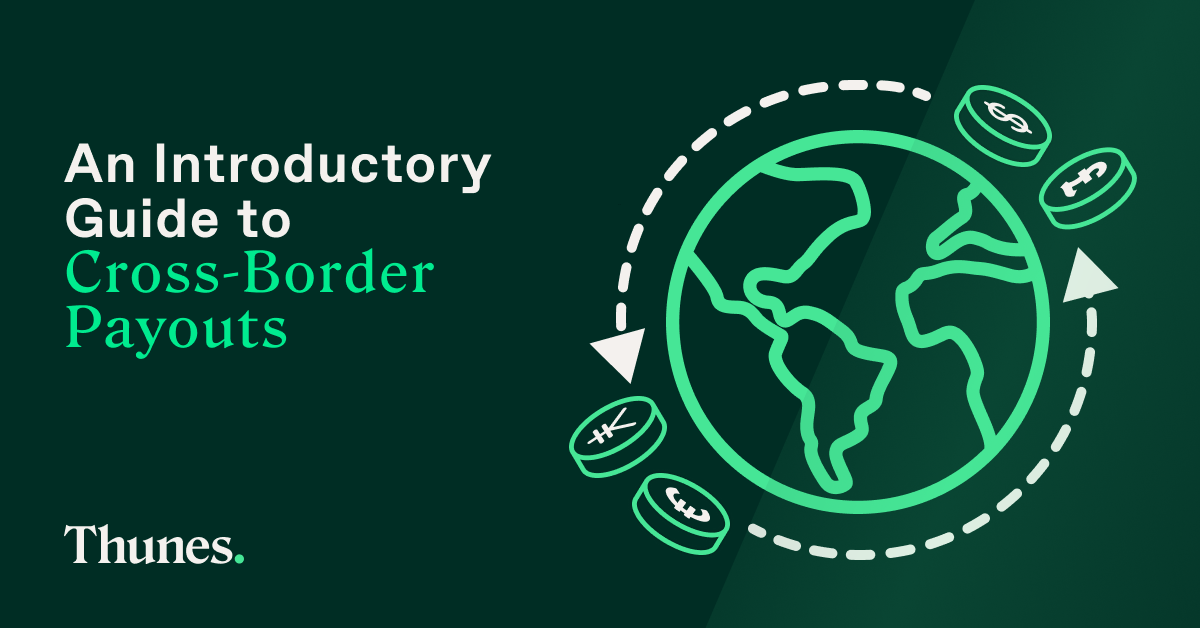
Global payouts are essential for businesses operating in international markets. To manage these payments effectively, businesses need reliable methods to send funds to recipients across borders, whether paying sellers, suppliers, workers or customers.
The complexity grows as businesses add more markets and payout volumes increase. Recipients may expect funds through bank accounts, cards, mobile wallets or other local payout methods, while businesses need to navigate different currencies and payment systems, manage FX and liquidity, meet regulatory requirements and maintain visibility across transactions.
This article explains what cross-border payouts are, how they work, the methods businesses can use, and the main operational challenges involved.
Table of contents
What are cross-border payouts?
Cross-border payouts are where a business or organisation sends funds to a recipient in another country.
They are used across a wide range of business models and use cases, from paying marketplace sellers and suppliers to distributing funds to gig workers, customers or other individuals. Depending on the payout, funds may also need to be converted from the sender’s currency into the recipient’s local currency.
The way recipients receive those funds can vary significantly between markets. Cross-border payouts can be delivered directly to bank accounts, cards, mobile wallets and other supported local endpoints, depending on the recipient’s location and preferred way to receive money.
Where can a cross-border payout actually be delivered?
Cross-border payouts can be delivered through different endpoints depending on the destination market, recipient and use case.
Supporting multiple payout methods gives businesses more ways to send funds through the financial services their recipients already use.
- Bank accounts: Funds can be delivered directly to a recipient’s bank account through banking networks and, where available, domestic payment rails. Bank account payouts are widely used for recipients such as suppliers, workers, merchants and consumers.
- Mobile wallets: Funds can be delivered directly to supported mobile wallets and mobile money accounts. This is particularly relevant in wallet-first economies where these services play a significant role in everyday financial activity and extend access beyond traditional bank accounts.
- Cards: Card payouts allow businesses to send funds directly to an eligible recipient card through supported card networks. They provide another route to recipients through existing card infrastructure across international markets.
- Stablecoin wallets: Supported stablecoins can be delivered directly to eligible wallets, providing an additional digital payout endpoint and liquidity options.
The payout method determines where the recipient ultimately receives the funds, but getting them there can involve different networks, currencies and local payment infrastructure.
The next step is understanding how those pieces connect within a cross-border payout.
How do cross-border payouts work?
A cross-border payout starts when a business or financial institution initiates a transfer to a recipient in another country.
The exact route depends on the countries, currencies and payout method involved, but the process generally includes:
- Payout initiation: The business provides the payout amount, currency and recipient details to its PSP or financial institution. That sending partner then submits the payout through its connection to the cross-border payout network.
- Transaction checks: Recipient and transaction information is checked against the requirements that apply to the payout before funds are sent.
- Currency conversion: Where the sender and recipient use different currencies, the funds are converted into the required payout currency.
- Payout routing: The transaction is routed towards the recipient through the relevant network and local payment infrastructure.
- Local delivery: Funds are delivered to the recipient’s chosen endpoint, such as a bank account, card, mobile wallet or stablecoin wallet.
- Confirmation and reconciliation: The sender receives information on the status of the payout, helping finance and operations teams track delivery and reconcile transactions.
The infrastructure behind these steps can vary considerably between markets. A payout to a bank account may need access to a domestic clearing or real-time payment system, while a mobile wallet payout requires connectivity to the wallet used by the recipient.
These differences create a growing integration challenge, especially at scale.
How do businesses manage cross-border payouts at volume?
As payout volumes and geographic coverage increase, payment providers and financial institutions need a way to access the banks, payment systems and payout methods required across each destination.
Broadly, businesses can take one of two approaches to building this payout coverage:
- Build and manage direct connections: Establish relationships and integrations with banking partners and local payment systems in the markets it serves. This offers greater direct control, but each additional market can introduce new integrations, data requirements, currencies and operational processes to manage.
- Use a global payout network: Connect to a network that provides access to multiple countries, currencies and payout methods through a single provider and common integration. The network manages the underlying connections into local payout environments, reducing the number of market-specific integrations the business needs to maintain.
At higher volumes, automation also becomes increasingly important. APIs can trigger payouts directly from business systems, while automated validation, transaction status updates, and reconciliation help teams manage large numbers of payouts without processing each transaction manually.
Why businesses use cross-border payout networks
For businesses expanding payout coverage across multiple markets, a global payout network can reduce the number of direct connections they need to establish and maintain. Beyond connectivity, the network model can also support faster local delivery, greater recipient choice and more consistent visibility across payout operations.
Access to more markets and payout methods
Recipient preferences differ significantly between markets. Bank accounts may dominate in one country, while mobile wallets or cards play a greater role elsewhere.
A cross-border payout network gives businesses access to multiple payout methods across different markets without requiring a separate integration or relationship for every correspondent bank, wallet provider, card network or local payment system.
Less operational complexity
Expanding payout coverage market by market can create a growing network of integrations and operational processes that need to be maintained.
Using a payout network allows businesses to manage multiple destinations through a more consistent technical and operational setup. This becomes increasingly valuable as payout volumes and geographic coverage increase.
Faster payout delivery
The time required to deliver a cross-border payout depends on the route and payout method involved. Access to domestic payment systems, real-time payment rails, card networks and mobile wallets can shorten the ‘last mile’ of the payout in supported markets.
Businesses can also route payouts towards the endpoint appropriate for each recipient rather than relying on the same delivery method across every destination.
Greater payout visibility
Businesses need to know whether a payout has been delivered, is still processing or has failed. This becomes harder to manage when payouts are sent through multiple providers and local systems.
A payout network can provide more consistent transaction status and reporting across markets, helping teams track payouts, investigate failures and reconcile transactions.
What makes cross-border payouts challenging?
The biggest challenge in delivering payouts across borders is that every new market, currency or payout method adds an additional layer of overhead, complexity and requirements.
Fragmented local payment systems
Payment ecosystems have developed differently from market to market. Bank networks, real-time payment systems, card infrastructure and mobile wallets can all play different roles depending on where a recipient is located.
Supporting these local payout environments can require numerous technical connections and relationships. Each new market or payout method can add another protocol or system that needs to be accessed and maintained, making international expansion progressively more complex.
Regulatory and compliance requirements
Cross-border payouts can be subject to requirements in both the sending and receiving markets. These can affect the information businesses need to collect, the checks performed before a transaction is processed and whether funds can be delivered to a particular recipient or destination.
Depending on the payout and markets involved, businesses may need to account for requirements around:
- Recipient identification and verification
- Anti-money laundering (AML) controls
- Sanctions and watchlist screening
- Transaction monitoring and reporting
- Market-specific transaction or currency requirements
FX and liquidity management
Cross-border payouts frequently involve sending and receiving funds in different currencies. Businesses need to manage when currencies are converted, the exchange rate applied and the amount the recipient ultimately receives.
Liquidity adds another consideration. Businesses making payouts across multiple markets need access to the currencies and funds required to execute those transactions, while payout demand can vary between corridors and over time. As geographic coverage and payout volumes increase, coordinating FX and liquidity across markets becomes a more significant treasury requirement.
Failed payouts and reconciliation
Not every payout reaches its recipient as expected. Transactions can fail or require further action for reasons including:
- Incorrect or incomplete recipient details
- Invalid or closed recipient accounts
- Missing information required by the destination market
- Unsupported payout methods or currencies
- Compliance or transaction screening issues
At high payout volumes, identifying and resolving these exceptions can create significant operational work. Businesses need visibility into payout status and failure reasons so teams can investigate problems, communicate with recipients and reconcile transactions accurately across markets.
Manage cross-border payouts with Thunes
Thunes’ Direct Global Network gives businesses access to payout endpoints across 140 countries and 90 currencies through a single connection, reducing the need to establish and maintain separate integrations market by market.
Interoperability is central to this model. Our network connects different payout ecosystems, from banks and card networks to mobile wallets and stablecoin wallets, allowing businesses to reach multiple recipient endpoints through the same global infrastructure.
Businesses can use the network to support different recipient needs through:
- Pay-to-Mobile-Wallets: Reach recipients through mobile wallets and mobile money services used in local markets.
- Pay-to-Banks: Send funds directly to bank accounts through Thunes’ global banking coverage and connections into local payment systems.
- Pay-to-Cards: Deliver payouts directly to eligible cards across supported card networks.
- Pay-to-Stablecoin-Wallets: Send supported stablecoins directly to eligible wallets as an additional digital payout option.
Beyond connectivity, Thunes brings together the treasury and compliance capabilities needed to support cross-border payout execution:
- SmartX Treasury System: Supports liquidity and FX management across markets, helping businesses manage the currencies required for payouts and coordinate how funds move and convert across the network. This reduces the operational complexity of managing liquidity across multiple payout destinations.
- Fortress Compliance Platform: Applies compliance controls across transactions moving through the network, including transaction monitoring and screening. This helps businesses manage cross-border payout flows across different markets through a consistent compliance environment.
Together, the Direct Global Network, SmartX and Fortress give businesses the connectivity and operational infrastructure to manage cross-border payouts across multiple markets through a unified network.
Contact Thunes to explore how our Direct Global Network can support your cross-border payout strategy.