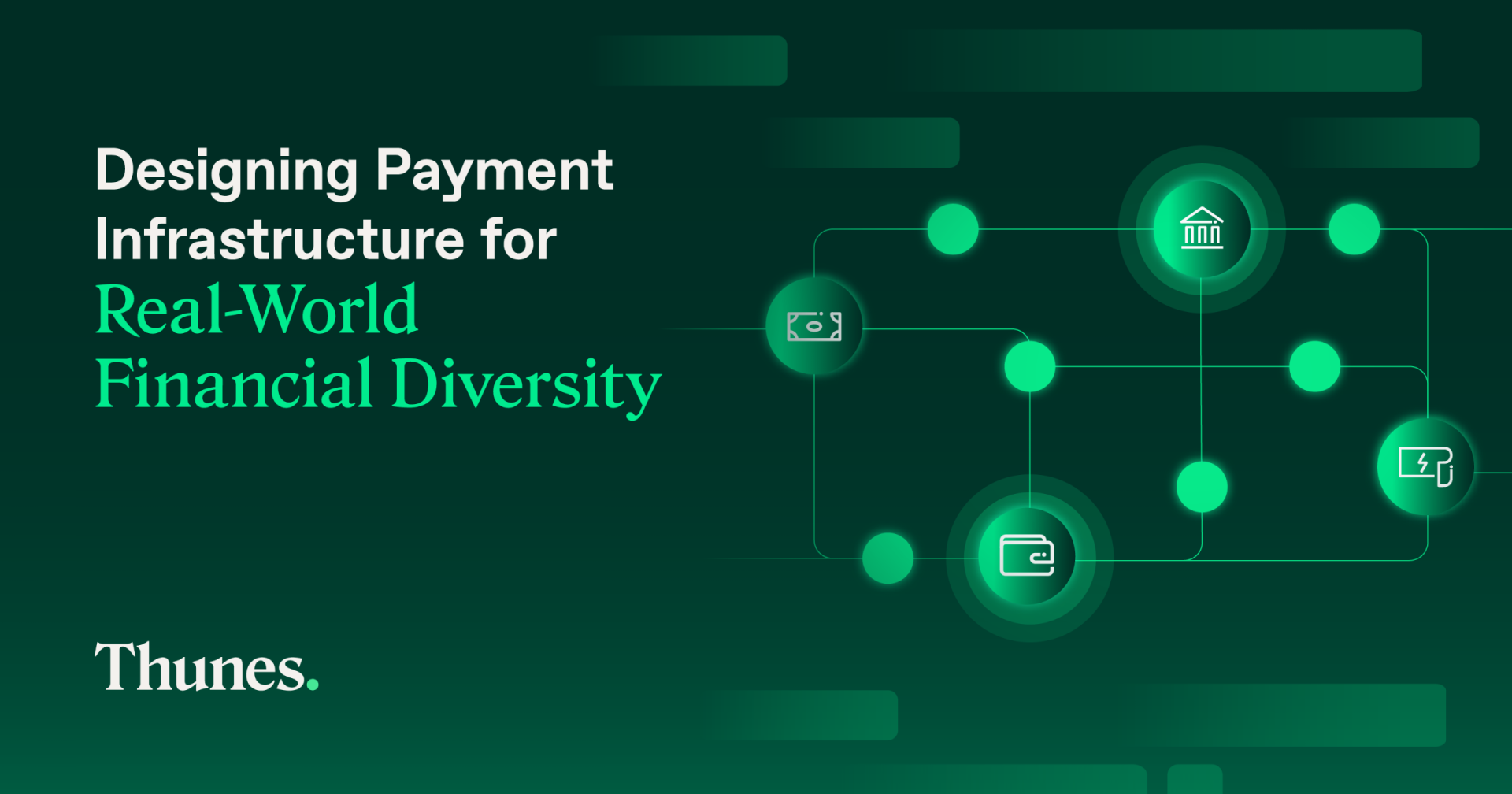
Designing Payment Infrastructure for Real-World Financial Diversity
For decades, the standard measure of financial inclusion was if a person either held a formal bank account or they did not. Policymakers, development institutions, and payment platforms built their access strategies around closing that gap, assuming that bringing someone into the banking system was synonymous with bringing them into the financial system. That assumption no longer holds.
The populations that traditional inclusion metrics classify as underserved have, in many cases, built thriving financial lives through instruments that never appear in bank account ownership data. They save through mobile money platforms, receive wages into digital wallets, and pay merchants via QR codes.
In the Philippines, Kenya, Indonesia, and Pakistan, mobile wallet ownership now outstrips formal bank account ownership. For money transfer operators (MTOs) and gig economy platforms, the operational consequence is direct.
Financial diversity is a reality that demands reflection
Payment behaviour across the world is not uniform, and designing networks as though it were is a structural failure with real impact.
Cash dominates daily transactions in the Philippines at 83% and Saudi Arabia at 72%. Bank transfers are the primary daily instrument in Nigeria at 67% and Brazil at 59%. No single rail serves everyone, and no single design assumption travels well across markets.
For gig workers, this diversity is especially pronounced. The Thunes Cross-Border Payments Interoperability Index shows they are nearly three times more likely to have used stablecoins than non-gig workers, and are five times more likely to hold funds in a non-resident digital wallet than those outside the gig economy. They use multiple payment methods simultaneously and switch between them based on speed, cost, and availability.
Standardising messaging layers between institutions improves data exchange but does not resolve last-mile disbursement into mobile wallets or agent networks. A payment that settles cleanly between correspondent banks can still stall at the point of delivery.
Interlinking fast payment systems across borders is technically achievable. The obstacle is prioritisation. Linkage projects have advanced where regulatory alignment and transaction volumes make the commercial case straightforward, leaving high-remittance corridors across Sub-Saharan Africa and South Asia underserved.
The gig economy is the sharpest test of whether infrastructure is inclusive
Gig workers represent the clearest stress test of cross-border payment infrastructure, and on most measures, the infrastructure is not passing.
The numbers are instructive. 63% percent of gig workers send or receive money internationally. 21% percent regularly support families abroad. 41% percent pay over 3% in fees on international transfers, consistently above the UN Sustainable Development Goals (SDG) target, despite being among the most digitally active users of payment platforms available.
The consequences extend beyond individual frustration. 11% of gig workers have lost or turned down work opportunities because their platform could not support payouts to a given country. That is both a workforce retention problem and a geographic expansion problem. A marketplace that cannot pay workers in Nigeria, the Philippines, or Bangladesh into the account type those workers actually use cannot effectively operate in those markets.
B2C disbursements to distributed workforces are among the fastest-growing cross-border payment use cases globally. The commercial opportunity is substantial, and it is accessible only to platforms whose payout infrastructure is built to reflect the diversity of the people doing the work.
What forward-thinking inclusion actually looks like in network design
Inclusive network design enables the recipient to decide how they receive money, and the platform’s infrastructure makes that possible.
A platform that disburses exclusively to bank accounts has made a design choice that structurally excludes a significant portion of the population in its highest-growth markets. Genuinely inclusive platforms build for wallet, bank, card, agent network, and stablecoin endpoints simultaneously, letting the architecture reflect the full diversity of the user base.
The progression toward more sophisticated interoperability models matters here. Bilateral linkages between two domestic systems represent a starting point. Hub-and-spoke models extend reach further.
Multilateral networks with shared technical and governance standards are where the most durable and scalable inclusion is achieved. Platforms that need to move in that direction quickly can do so by connecting to infrastructure that already operates across those models rather than building sequentially toward them.
Transparency is an inclusion requirement that sits alongside reach. 41% percent of senders globally are not consistently shown the final recipient amount upfront. For a gig worker sending earnings to family in Manila or Lagos, an unexplained deduction is a trust failure that pushes users toward informal channels.
Thunes addresses this through real-time transaction visibility and enriched data reporting built into every payment flow, giving senders and recipients clarity on timing, amount, and delivery status.
Meeting access targets by 2027 means ensuring individuals and businesses can send and receive international payments through regulated channels. In markets where mobile wallets and agent networks are the primary financial instruments in use, that goal requires platforms to actively integrate the payment methods underserved populations already rely on.
Interoperability is the infrastructure of inclusion
The markets that score highest on financial inclusion and cross-border connectivity share a common architectural trait. They have connected their domestic rails to diverse last-mile disbursement networks, supported by regulatory frameworks that actively enable interoperability across payment types. That combination produces faster payments, lower costs, and higher trust among the populations who depend on cross-border transfers most.
Singapore’s position as second in the overall Thunes Cross-Border Payments Interoperability Index illustrates what alignment between government, central bank, and private sector can produce. Bilateral fast-payment linkages with India, Malaysia, Indonesia, Thailand, and the Philippines did not emerge from market forces alone. They were the result of deliberate infrastructure investment and coordinated policy.
For MTOs and gig platforms, the commercial and inclusion imperatives point in the same direction. The corridors carrying the highest remittance volumes and the fastest-growing gig workforces are precisely where payment diversity is greatest and where single-rail approaches are most visibly inadequate.
Thunes connects to over 12 billion mobile wallets and bank accounts, 500 million stablecoin wallets, and 15 billion cards across 140 countries through a single API. That breadth reflects what genuine inclusion requires in practice: infrastructure that reaches every payment method, every market, and every user, without asking any of them to change how they participate in the financial system.
Contact us to connect your customers to the payment methods they already use, wherever they are.