Interoperability is the only way to close the last-mile remittance gap
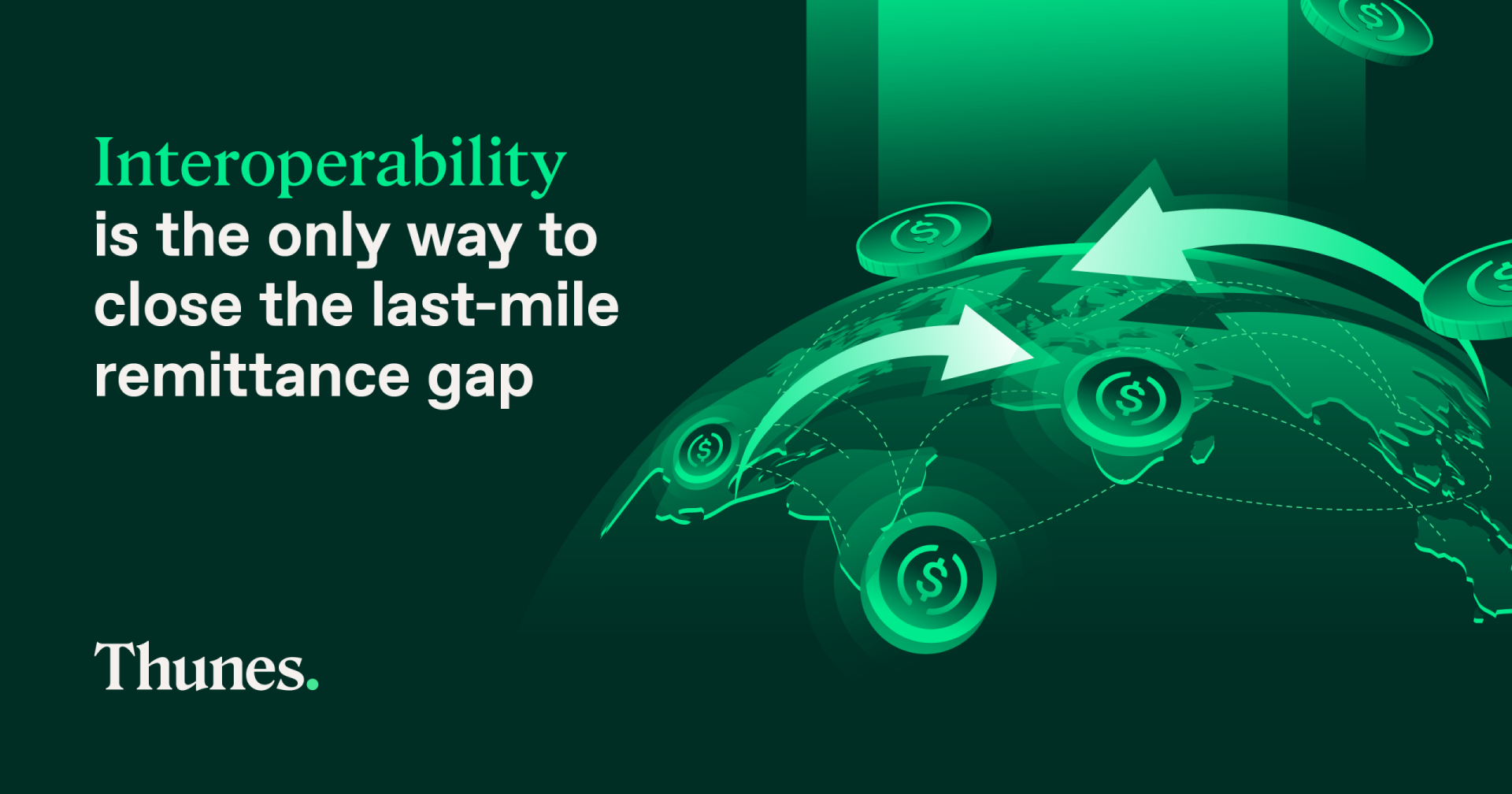
Interoperability is the only way to close the last-mile remittance gap
Every year on 16 June, the United Nations marks the International Day of Family Remittances – a day to recognise the more than 200 million migrant workers who send money home to support around 800 million family members.
For many of those families, the money arrives. The problem is when.
While the day has been recognised for more than a decade, progress on improving the speed, reliability, transparency and cost of remittances has remained painfully slow.
Thunes data shows that worldwide, one in three (33%) remittance recipients struggle to pay for food, rent, or utilities because essential funds being sent to them are trapped in fragmented cross-border payment systems.
Closing this gap is largely a question of interoperability: getting the world’s payment systems to talk to each other.
In this article we look at how:
- The two speeds of money leave a gap in between
- The cross-border gap is now more visible than ever
- Problems with speed centre around the most financially vulnerable
- The last-mile problem is where speed runs out
- Closing the gap requires depth and breadth
The two speeds of money leave a gap in between
The global financial system is currently operating at two completely different speeds. Within many national borders, moving money has become easy and near-real-time, yet the moment capital needs to cross a frontier, infrastructure slows to a crawl.
More than seventy countries have now successfully deployed near or real-time domestic payment infrastructure, operating at a near-zero cost to the consumer.
Citizens in Brazil, India, and Nigeria now expect and experience instant financial settlements as a routine part of daily life, readily using these systems to buy groceries, settle bills, and transfer funds to family members instantly.
So, what will it take to deliver that same service, overseas?
The cross-border gap is now more visible than ever
Globally, 27% of people receiving cross-border payments still have to wait two or more days for their money to arrive. In Brazil, despite the massive success of the local Pix network, strict currency controls mean 42% of international recipients still face multi-day delays.
Data from the Thunes Cross-Border Payments Interoperability Index, conducted in association with Juniper Research, shows that many international transactions remain trapped in a global deadlock. This friction is a direct consequence of fragmented engineering and parallel financial ecosystems developing in isolation.
Domestic payment networks rely on differing technical standards, incompatible messaging formats, and separate regulatory frameworks. Because these systems lack a common language, they are fundamentally unable to communicate directly with one another across borders.
Within a home country, the payment speed benchmark for ‘good’ is now seconds. Even on traditional cross-border rails, the SWIFT GPI service credits nearly 60% of payments within 30 minutes and almost all within 24 hours. In the EU, banks are now required to move instant payments within 10 seconds, at no extra charge. Against that, a two-day wait for grocery money is incredibly slow – yet it persists.
Problems with speed centre around the most financially vulnerable
The families who most depend on remittances are the ones the current system serves worst.
The World Bank Global Findex highlights that rural, female, and low-income populations are both the most remittance-dependent and the least likely to hold a formal bank account. When international transfers stagnate in transit, these vulnerable groups are left with zero financial options.
For unbanked communities and those outside traditional banking standards, challenges around endpoints are inextricably linked to the speed of the transfer itself.
Here, mobile wallets and local cash pickup locations are not inferior alternatives to traditional finance. They serve as the primary financial infrastructure in emerging markets where physical bank branches are scarce or entirely inaccessible.
The issue is that in too many cases, even if a payment travels instantly between major global financial hubs, overseas payments cannot connect the payment source to the endpoint, however suitable it is for the local market.
The human cost of that final-step failure is documented in Thunes’s research. Among people who rely on remittances from family, 82% hit at least one problem with a payment over the past year.
One in three struggled to cover essentials. Nearly a quarter said payment problems had strained their relationship with the family member sending support.
The last-mile problem is where speed runs out
These systemic failures are highly concentrated at the point of destination, specifically when attempting to credit a local bank account or disburse funds into a mobile wallet without direct interoperability with the receiving network.
India illustrates this structural gap with striking clarity. The Unified Payments Interface (UPI) is widely recognised as one of the most advanced domestic payment networks in the world, handling billions of seamless local transactions.
Despite this world-class internal infrastructure, cross-border payments entering India remain among the slowest surveyed. Only 33% of Indian inbound international transfers are received instantly or within the same day of sending, with 46% of people left waiting two or more days.
This friction persists even as consumer preferences shift toward digital-first options. Mobile wallets have quickly become the preferred front-end channel for international transfers globally, capturing nearly 48% of the market.
The remittance challenge is that the majority of these platforms operate as closed-loop systems. This insular design prevents seamless inbound disbursement from foreign financial networks, leaving users isolated from global capital flows.
Overcoming this does not require building entirely new networks from scratch. The solution lies in connecting existing infrastructure.
Closing the gap requires depth and breadth
Financial institutions know that endpoint depth matters far more than network breadth when it comes to their cross-border connections.
Effective connection demands integration into real-time rails, alongside direct participants in local schemes, and via direct connections to specific mobile wallet providers, cash pickup networks, and bank schemes. Serving people across fragmented, often unbanked markets means investing heavily in local licensing, anti-money-laundering capability, and identity verification tailored to each market.
This is what Thunes has spent years on. Its proprietary Direct Global Network connects directly into mobile wallets, bank accounts, and cash networks across more than 140 countries and 90 currencies, reaching the local endpoints – GCash, M-Pesa, and many others – that remittance recipients rely on.
The point isn’t the size of the network but that the money lands where the recipient can actually use it, in the form they actually use.
While problems with remittances continue to have a profound effect on people around the world, there is huge positivity to be taken from what domestic innovation has already achieved in terms of speed and scale. The job now is to bridge those fast domestic systems, across every border.
Contact us to learn how Thunes can connect your business directly to the global network and last-mile wallets in your key markets.