Why Real-Time Payment Compliance Is a Competitive Advantage
Speed is the defining feature of modern payments. But while payments move faster, compliance frameworks are struggling to keep up.
In a real-time environment, providers must be able to monitor risk, enforce controls and produce regulatory evidence without slowing the payment experience. That’s harder than it sounds.
Compliance can’t occur after the fact. It must operate alongside the payment itself and become part of the infrastructure that enables money to move at speed.
In this article, we look at why real-time compliance is becoming the biggest competitive advantage in payments.
Table of contents
The trends driving the real-time payment shift
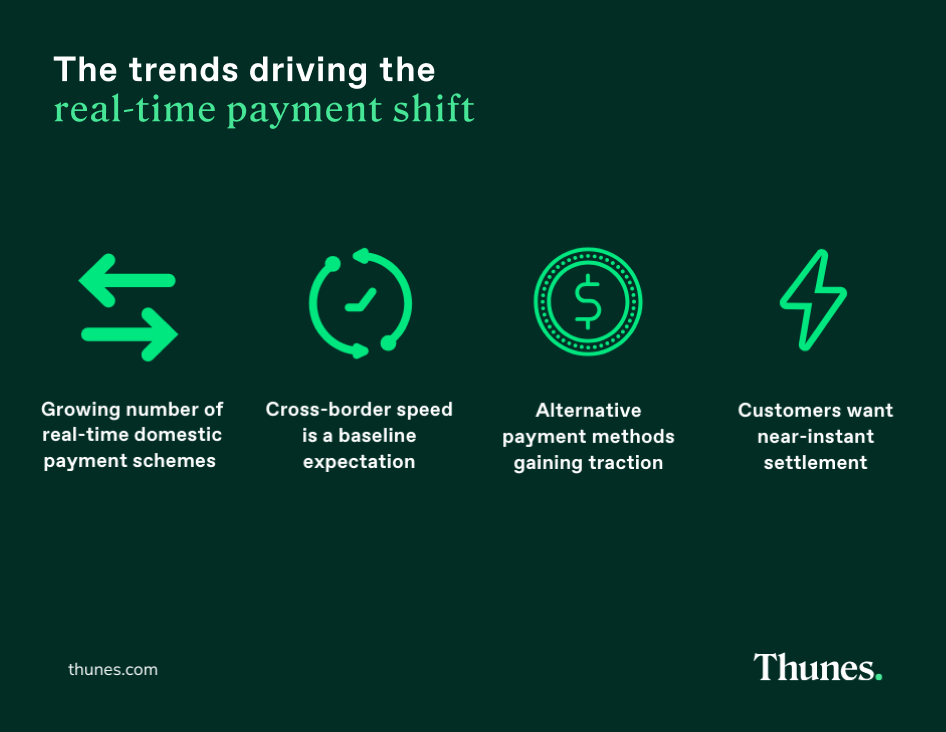
Global payment infrastructure is changing quickly. Real-time settlement is expanding across domestic payment systems, cross-border payouts, and emerging digital rails, and the pace is not slowing down.
Several trends are driving this:
- Real-time domestic payment schemes are now live in more than 70 countries, enabling instant account-to-account transfers within national markets.
- Cross-border payout expectations are moving toward near-instant delivery, particularly for remittances, marketplaces, and platform payments, even in challenging and emerging markets.
- Stablecoin and digital settlement models are being tested for cross-border use cases, introducing alternative methods of moving value between jurisdictions.
- Customers increasingly expect settlement within minutes rather than the multi-day timelines historically associated with international transfers.
Why traditional compliance models struggle in real-time environments
Legacy compliance was designed around the simple assumption that there is time between payment initiation and final settlement. That window allowed institutions to review transactions or escalate investigations, and apply corrective actions before funds moved between accounts or to wallets.
Real-time payment systems have removed that window almost entirely.
When transactions settle in seconds, retrospective checks are too slow to be effective. Controls need to operate at the moment the transaction occurs, not after it is completed. That requires a fundamentally different approach to how monitoring systems are built and when they run.
The goal is not to slow everything down in the name of caution, but to apply the right controls at the right moment, without creating a bottleneck that the payment speed makes unworkable.
The gap between payment speed and regulatory oversight
Payment providers operate between two sets of demands that pull in opposite directions: trying to give customers fast, predictable payments and meeting the demands of regulators.
An expectation gap appears when these demands collide in day-to-day operations.
- Customers expect instant settlement, particularly in real-time account-to-account transfers and cross-border payouts.
- Compliance teams must apply layered checks, including sanctions screening, transaction monitoring, and documentation requirements.
- Cross-border payment flows introduce varying rules, with different reporting standards and regulatory expectations in each market.
For PSPs and MTOs, the stakes on both sides are real. Compliance that slows payments affects the customer experience, while controls that are cut back to preserve speed increase regulatory exposure.
The operational friction in scaling real-time payments
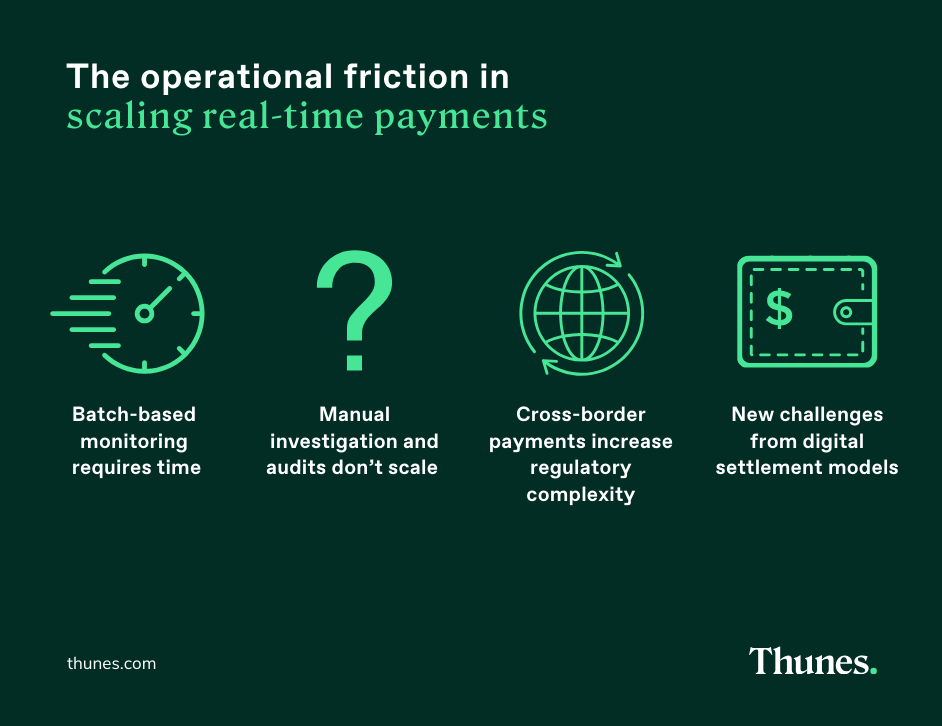
As payments accelerate, several operational pressure points become more visible.
Batch-based monitoring in a real-time world
Scheduled batch monitoring was built for environments where settlement took time. In real-time systems, that timing assumption breaks down.
Take a remittance provider sending instant payouts across multiple markets. A transaction settles through a domestic real-time rail. Sanctions monitoring runs in a batch cycle twenty minutes later; by the time a potential match is flagged, the funds have moved. The compliance team can investigate, but the payment has already settled.
Cross-border payments increase regulatory complexity
A single international payment can pass through multiple jurisdictions before reaching the beneficiary, whether that’s banks, financial institutions, or third parties. Each one carries its own sanctions lists, reporting standards, documentation requirements, and beneficiary identification rules.
Providers must be able to account for:
- Region-specific sanctions and watchlists
- Local reporting and documentation requirements
- Variations in regulatory interpretation and enforcement
- Differences in beneficiary identification standards
As cross-border volumes grow, managing these requirements manually becomes increasingly difficult.
Manual investigation and audits don’t scale with payment speed
Investigation queues, human review processes, and internal escalation paths were designed for environments where analysts had time to work through cases methodically. Investigations that occur after settlement may resolve compliance concerns, but can’t prevent operational disruption or customer impact.
The same applies to audits. When a compliance review is triggered, providers need to reconstruct a clear picture quickly. If a transaction has touched several intermediaries, monitoring results, screening logs, and transaction records may sit across different internal systems.
Even when controls were applied correctly, assembling the evidence takes time. Fragmented compliance infrastructure turns a straightforward audit trail into a resource-intensive exercise.
New challenges from digital settlement models
Stablecoin and digital asset rails introduce wallet-monitoring requirements, transparency expectations, and counterparty-risk considerations that sit on top of existing AML and sanctions obligations.
A provider experimenting with stablecoin-based settlement still needs to maintain traditional controls for the underlying payment flow, while simultaneously monitoring wallet addresses and tracking on-chain activity. That means two oversight environments have to run in parallel and work together.
Without integrated, real-time controls, scaling across both increases operational risk and compliance cost.
Embedding compliance into payment execution
The response to these pressures is not to add more complexity with headcount or operational layers.
The only sustainable response is a compliance infrastructure that runs at the speed of the payment itself.
In the year ahead, this will translate into real-time compliance as providers invest in:
- AI-assisted sanctions and AML screening
- Adaptive risk scores that adjust with behaviour and context
- Consolidated case management for alerts across rails
- Evidence frameworks that can be explained to regulators in clear terms
Thunes provides this through its Direct Global Network and Fortress Compliance solution, offering a single operational framework that replaces corridor-specific controls with consistent, embedded standards.
Unified controls across borders
A single API integration to Thunes’ Direct Global Network applies transaction monitoring, sanctions screening, and regulatory data requirements consistently across markets.
Local obligations are handled at the network level, so providers can access multiple markets without building or maintaining separate compliance logic for each corridor.
For a PSP expanding into several new payout markets, this removes the operational overhead of managing different beneficiary data requirements, screening logic, and reporting formats market by market. The network handles that complexity. The provider operates against a single, consistent framework.
Continuous monitoring with audit-ready traceability
Fortress Compliance embeds risk controls directly within transaction flows rather than running alongside them. Screening and monitoring operate continuously, applying controls at the moment the transaction occurs rather than in a scheduled batch cycle after settlement.
Core capabilities include:
- Real-time screening. Transactions are scanned against international sanctions lists, PEP databases, and watchlists at the point of execution.
- Continuous transaction monitoring. Payment flows are monitored for anomalies and suspicious activity as they occur, not retrospectively.
- Dynamic risk scoring. Risk is assessed continuously across multiple data points, adapting to transaction context rather than applying static rules.
- Liquidity and currency flow analytics. Forecasting models analyse currency flows to support liquidity planning across corridors.
- Global regulatory coverage. Operating under more than 50 licences worldwide, including the FCA, MAS, ACPR, and all 50 US states.
- Data security standards. Certified under ISO 27001 and PCI-DSS, with tokenisation and encryption across transaction and customer data.
When a compliance review is triggered, transaction records, screening logs, and monitoring results sit within a single system, reducing the time and effort needed to produce regulatory evidence.
The result is payment infrastructure that scales across corridors without compliance becoming the bottleneck.
Real-time payment compliance that scales
Instant settlement is now a baseline expectation. The providers that scale from here will be those whose compliance infrastructure was built to match it, not bolted on afterwards.
Thunes addresses it at the infrastructure level, embedding controls directly into the payment layer through its Direct Global Network and Fortress Compliance, so regulatory standards are maintained across markets without becoming a bottleneck.
Speak with a Thunes expert to learn how embedded compliance supports faster, more reliable cross-border payments.