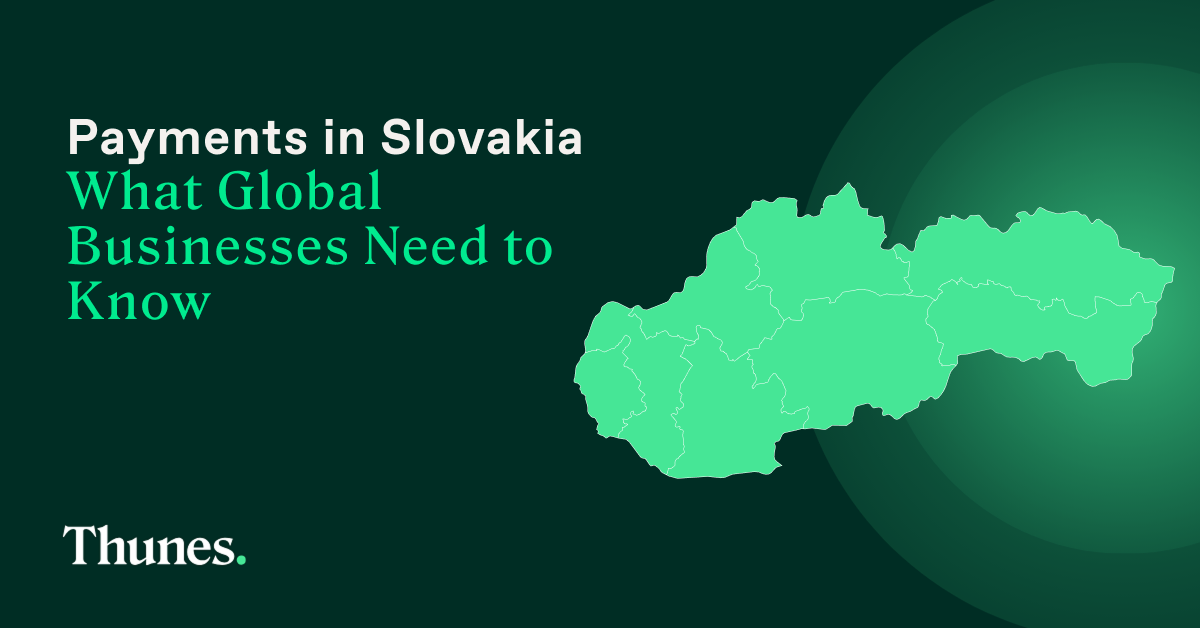
Payments in Slovakia: What Global Businesses Need to Know
Slovakia has strong financial and labour links with markets across Europe, creating regular flows of money into the country. Slovaks working abroad receive earnings across borders and send money home, while businesses also need to pay suppliers, freelancers, insurance claimants and gig-economy workers in the market.
For PSPs, MTOs and global businesses facilitating these payments, Slovakia’s high level of bank-account ownership makes bank accounts an important destination for reaching recipients. Its connection to SEPA, including SEPA Instant, also provides established rails for moving EUR into the country.
This article looks at the cross-border flows that shape payments into Slovakia, where friction still appears, and how global businesses can reach recipients efficiently in the market.
Table of contents
- A highly banked economy connected to European payment infrastructure
- The local payment heroes in Slovakia
- Slovakia is a market that both sends and receives
- Where global businesses can still hit friction
- How Thunes connects to payments in Slovakia
- What does this mean for payment strategy in Slovakia?
- Connecting Slovakia to global payment flows
A highly banked economy connected to European payment infrastructure
Slovakia combines widespread access to banking with close integration into Europe’s payment systems. With a population of 5.4 million and internet penetration of 89.8%, it is a relatively small but highly connected market, where digital financial services are accessible to much of the population.
That access extends into financial services:
- 92% of people aged 15 and over have a bank account
- There are approximately 4.2 million bank accounts across the country
As a member of the euro area, Slovakia uses the euro and participates in the Single Euro Payments Area (SEPA), which connects its banking system to a common framework for euro payments across Europe. Since October 2025, Slovak banks have been required to support both sending and receiving SEPA Instant payments, allowing eligible euro transfers to reach another participating account within seconds, 24 hours a day.
That matters for businesses and payment providers sending money into Slovakia. Remittances, business payments, freelancer earnings, insurance payouts and gig-economy payments can all involve recipients who want quick access to funds in their bank accounts.
The key point: Slovakia is not a market where global businesses first need to overcome limited access to finance. Most consumers are already banked, connected and accustomed to digital financial services. For businesses sending money into the country, the challenge is reaching recipients through payment infrastructure and local rails that match the reliability and speed they already expect locally.
The local payment heroes in Slovakia
Slovakia already has a mature domestic payment experience. Consumers are accustomed to contactless card payments, established bank transfers and increasingly instant movement of money between accounts. In that sense, the local market has already set a high standard for speed and convenience.
The opportunity now is for cross-border payments to move closer to that domestic experience. When recipients are accustomed to fast payments locally, international remittances, business payments and other incoming payouts can feel out of step if they take longer to arrive or involve more friction.
Cards remain central to everyday payments
Cards are one of the most established ways to pay in Slovakia. A 2025 Payments Europe survey found that cards were the preferred payment method among consumers and merchants, and 92% of consumers reported being satisfied with the payment options available to them.
Contactless use is also widespread. According to ECB data cited by Stripe, contactless transactions accounted for 84% of POS card payments in Slovakia in 2022, up from 77% in 2019.
Bank transfers remain important for domestic and cross-border payments
Bank transfers and SEPA Direct Debit are also established parts of the market, particularly for bills, e-commerce, and B2B payments. Slovakia’s participation in SEPA means euro-denominated transfers can move through standardised payment schemes shared with other participating European markets.
That role is expanding as instant payments become more widely available – and that matters for Slovakia’s cross-border payment flows.
Slovakia is a market that both sends and receives
Slovakia’s cross-border payment flows move in both directions. Slovaks working elsewhere in Europe generate substantial incoming flows, while a growing foreign workforce creates demand for payments moving from Slovakia to other markets.
Money flowing into Slovakia
Around 390,000 Slovaks were living abroad in 2024, with 95% based elsewhere in Europe. Czechia accounted for the largest share at 59%, followed by Austria at 13%, Hungary at 6% and Switzerland at 6%.
That cross-border workforce helps explain the scale of money flowing back into Slovakia. Remittances received reached USD 3.20 billion in 2025, although that figure also includes compensation earned by border, seasonal and short-term workers. It captures more than traditional person-to-person remittances sent home by people living permanently abroad.
A good example is the Austrian care corridor. Almost 60,000 live-in carers work in Austria on two- or four-week rotations, with Slovaks among the most represented nationalities. Labour patterns like these help explain why neighbouring European markets feature so prominently in Slovakia’s incoming payment flows.
This creates a clear inbound use case: getting funds into local bank accounts quickly and reliably, whether the payment is a remittance, a business transfer, a freelance payment or another form of recipient payout.
Money flowing out of Slovakia
The flow also moves in the opposite direction. Migrants in Slovakia sent USD 522 million abroad in 2024, supported by a foreign workforce that now plays an important role in several parts of the economy.
- A growing foreign workforce. Around 150,000 foreign nationals currently work in Slovakia, with employment concentrated in Bratislava, Trnava and Nitra.
- Strong links to manufacturing. Of more than 153,000 foreigners holding residence permits at the end of 2024, around two-thirds were employment-based, and foreign workers are heavily concentrated in manufacturing and factory-floor roles — tying cross-border labour flows directly to Slovakia’s industrial base.
- Workers come from a broad mix of markets. Ukraine, Serbia and India account for a large share of the foreign workforce, alongside people from neighbouring EU countries, the Philippines and former Soviet republics.
- Ukraine has added another important cross-border population. More than 137,000 people who fled Ukraine held temporary protection in Slovakia as of October 2025, adding to the number of people with financial ties beyond Slovakia’s borders.
For payment providers, the significance is straightforward. Slovakia supports both inbound and outbound cross-border flows, driven by people who live, work and earn across multiple European markets.
Where global businesses can still hit friction
SEPA removes a lot of the complexity from euro payments into Slovakia, but it doesn’t make every international payment behave like a domestic transfer.
Slovakia’s financial transaction tax adds a local cost consideration
One of the clearest Slovakia-specific considerations is the financial transaction tax. From 2026, the tax applies to legal entities, with most debits from a taxable transaction account charged at 0.4% of the transaction value, capped at EUR 40 per transaction.
Its reach can extend beyond Slovak companies. A foreign legal entity with an account at a Slovak bank can fall within scope for transactions made from that account, even where it does not operate through a permanent establishment in Slovakia.
That means the economics of moving money in Slovakia need to be considered alongside the payment rail itself. Being connected to SEPA doesn’t mean every transaction carries the same cost structure as it would elsewhere in the euro area.
SEPA simplifies euro payments, but not every cross-border flow
The picture changes when a payment moves outside SEPA’s euro rails.
At Slovenská sporiteľňa, one of Slovakia’s largest banks, cross-border payments in currencies such as USD, GBP, CHF, CZK and HUF are supported through its correspondent banking network and Swift. These payments can involve intermediary banks, additional fees and FX conversion where the payment and account currencies differ.
The last mile can add another layer of complexity. Businesses sending money into Slovakia still need a way to connect international payment flows with local bank accounts, while managing the different requirements, limits and processing times that can apply to each flow.
Compliance remains part of the payment flow
Slovakia operates within the wider EU regulatory environment for payments, including requirements around customer authentication, anti-money laundering controls and data handling.
Verification requirements are also becoming more visible within the payment experience itself. Slovak banks now use Verification of Payee for euro payments, checking that a recipient’s name matches the IBAN details held by the receiving bank.
For global payment providers, that means faster and more standardised European rails still need to be matched with accurate beneficiary data and the controls required to move money safely.
How Thunes connects to payments in Slovakia
For PSPs, MTOs and other businesses sending money into Slovakia, Thunes provides direct access to local bank accounts through a single connection to its Direct Global Network. This supports a range of inbound use cases, including remittances, business payments, freelancer earnings, insurance payouts and gig-economy payouts.
- Bank payouts across Slovakia. Thunes supports EUR payouts to all banks in Slovakia through SEPA, covering C2C, B2C, B2B and C2B payment flows.
- Real-time delivery where SEPA Instant applies. Payments below EUR 100,000 can be delivered in real time when the beneficiary bank supports SEPA Instant, while higher-value payments are processed on a T+1 basis.
- Account validation. Bank payouts include account validation, helping Members check recipient details before funds are sent.
- Card payouts as an additional option. Thunes also supports EUR payouts to eligible Visa and Mastercard cards for C2C and B2C use cases.
- Real-time compliance and FX management. Fortress Compliance Platform supports real-time screening and compliance controls across payment flows, while the SmartX Treasury System helps Members manage FX, liquidity and treasury operations across currencies and markets.
These capabilities give Members a consistent and compliant route to broad bank-account coverage, with real-time delivery available for eligible payments and card payouts available as an additional option.
What does this mean for payment strategy in Slovakia?
The biggest opportunity is to match that local payment environment with the right payout route for each use case.
- PSPs can access Slovak bank accounts and eligible cards through a single connection, supporting a broader mix of consumer and commercial payment flows.
- MTOs and remittance providers can use real-time bank payouts where SEPA Instant conditions are met, helping recipients access funds faster.
- Businesses can reach suppliers, employees and other commercial recipients through EUR bank transfers without building separate local banking connections.
- Marketplaces and digital platforms can support payouts to sellers, freelancers and customers via bank accounts or eligible Visa and Mastercard cards.
The key is choosing the local payment route that best fits the recipient, transaction type and required speed.
Connecting Slovakia to global payment flows
Slovakia is a highly banked, digitally connected market with strong payment links across Europe. For businesses moving money into the country, meeting local expectations means combining that regional connectivity with reliable access to the payment methods and rails people already use.
Thunes helps Members reach recipients across Slovakia through local bank accounts, supported by real-time payment rails where available, with card payouts as an additional option.
Contact our team to connect to Slovakia through Thunes’ Direct Global Network.