The Rise of Digital Payments in South Africa
Digital payments in South Africa are experiencing a significant shift, growing into a broader payments ecosystem that spans banks, cards, wallets, and real-time, account-to-account rails.
As smartphone usage rises and cash becomes harder to manage for both consumers and merchants, digital payments in South Africa are becoming the default way to move money for many segments. For global businesses, that changes how to think about reach, conversion, and the cost of serving South African customers.
This article looks at how payments in South Africa work today, why the market is edging toward wallets and super-app models, and how global platforms can plug into this growth.
Table of contents
- Digital payments in South Africa
- How digital payments have evolved into broader financial ecosystems
- Why South Africa is moving toward the super app model
- What does this shift mean for global businesses?
- How Thunes connects to South Africa’s digital payment ecosystem
- Connect to digital payments in South Africa
Digital payments in South Africa
To understand where the market is heading, it helps to look at how people actually use digital payments on the ground.
Banks are modernising digital payments
Physical banks remain a core part of South Africa’s payment system, but increasing numbers of customers are starting to use digital payment experiences.
To meet this growing demand, banks are expanding digital payment capabilities in their apps, including instant account-to-account transfers, QR code payments, and contactless payments. Initiatives led by the South African Reserve Bank, including the Rapid Payments Programme and PayShap, are accelerating this shift by enabling real-time payments using mobile numbers or other identifiers.
Together, these changes are turning banks into digital payment platforms that operate alongside wallets and fintech apps. For businesses, this means a broader mix of bank- and wallet-based payment options built on modern, real-time infrastructure.
Digital payment adoption is growing across banked and underbanked consumers
Most South Africans now carry a smartphone. For many households, that device is the main connection to banking, shopping, and public services. Even consumers with traditional bank accounts are finding it easier to manage day-to-day finances through mobile banking apps and connected wallets.
For people who are underbanked, wallets fill a clear gap:
- Someone working in a city can send money home to a relative in a rural area using only a mobile number.
- A recipient without a bank card can withdraw at an ATM or a supermarket till.
- Small, irregular income can be stored digitally for bills or emergencies rather than kept in cash.
This frequency of use is what turns a wallet into a daily financial hub instead of an occasional cash-out tool.
Crypto and stablecoin penetration
With limited access to banking in some segments, currency volatility, and demand for faster cross-border value movement, cryptocurrencies have been gaining popularity in South Africa.
The country’s largest licensed crypto platforms, Luno, VALR, and Ovex, have seen their total asset value jump from under R10 billion ($590 million) in 2023 to R25.3 billion ($1.49 billion) at the end of 2024. These platforms had nearly 7.8 million users in July 2025, and around 10% of the population now owns or uses cryptocurrencies – in most cases for investment trading – higher than the world average of 6.9%.
Stablecoins are following a similar trajectory. In 2024, stablecoins accounted for 43% of all digital asset transactions in the region, and trading in USD-pegged stablecoins reached over R80 billion ($4.7 billion) by October 2025.
For global businesses, this trend highlights the growing role of stablecoins as a settlement and funding layer, particularly when combined with local digital wallets and bank-based payment rails in South Africa.
The dominant players and payment rails
Different types of providers are competing for control of the digital payments market in South Africa.
On the banking side, services such as FNB eWallet and Standard Bank Instant Money all started with cardless cash-out and domestic remittances. Over time, they have added in-app payments, bill pay, and limited savings features. Global wallets such as Apple Pay, Samsung Pay, and Google Pay are also gaining traction, particularly among urban and higher-income consumers with contactless-enabled devices.
Telecom and digital-first banks sit alongside them. MTN MoMo, TymeBank, and the broader Capitec digital ecosystem combine communications, payments, and financial products in app environments that feel closer to emerging super apps. Retailers and fuel chains are also building digital payment experiences inside their loyalty and store apps.
Underneath these consumer brands, the payment rails are shifting as well. PayShap and other real-time account-to-account schemes are making it easier to move funds instantly between banks and, increasingly, between banks and wallets. This real-time infrastructure underpins many digital payment experiences, whether the user interacts through a bank app, a wallet, or a merchant checkout.
How digital payments have evolved into broader financial ecosystems
The earliest South African digital payment solutions solved a single problem: helping users send money and cash it out. Today, the same rails support a much wider range of financial activity.
From simple transfers to multi-functionality
Most leading wallets now support:
- In-app or QR code payments at informal traders, spaza shops, and formal retailers
- Bill payments for utilities, TV, and other recurring spend
- Airtime, data, and prepaid electricity purchases within the app
These expanded uses matter because they keep value within the digital environment for longer.
A consumer might receive a salary top-up or remittance into a wallet, pay three or four bills, buy electricity, and only then withdraw what is left. That is a very different pattern from cashing out the full amount at once.
From stored value to savings and credit
Providers are layering more financial products into the wallet experience. It could be simple savings pockets with small minimum balances, short-term loans, buy-now-pay-later offers based on observed wallet activity, or loyalty rewards or cash-back incentives that encourage recurring use.
These features shift the role of a wallet. It becomes the place where people see all their day-to-day money, not just a channel for one-off transfers. That creates a direct challenge for banks, telcos, and retailers, each trying to own the customer’s primary financial app.
Growing competition for everyday engagement
The race to capture attention means providers are building integrated experiences that link payments to lifestyle and commerce and clear, predictable fee structures for low-value transactions. They’re also improving onboarding, making it faster, remote and workable even with limited documentation.
Wallets are a powerful route to financial inclusion, especially in emerging markets. They make it possible for people with thin credit files, irregular income, or limited access to branches to participate in the digital economy.
Why South Africa is moving toward the super app model
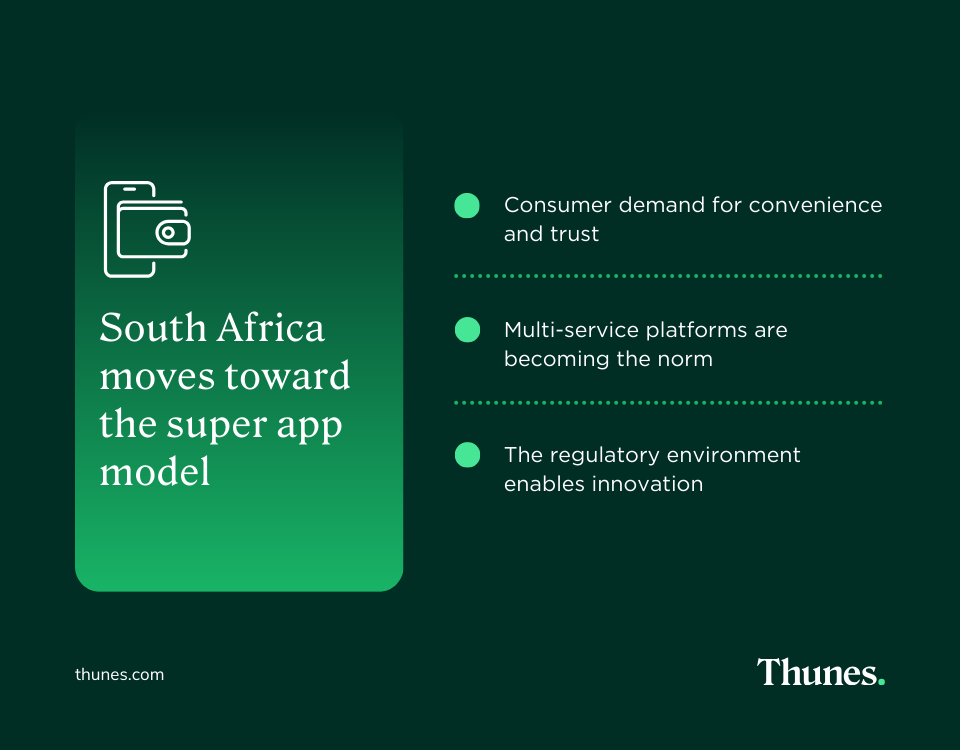
As more use cases and features are added, digital wallets often move into super-app territory. The same is playing out in South Africa, where one or two applications are becoming the command centre for a user’s financial and everyday life.
Consumer demand for convenience and trust
For many consumers, juggling multiple apps with different logins, fee structures, and interfaces is too much effort. If they can pay for a taxi, make online payments, split a bill with friends, and access credit from one familiar environment, that is the most favoured solution.
Trust also plays a big role. Consumers feel more comfortable using a wallet associated with a major bank or large retailer they already know. When that brand extends into more services inside the same app, adoption can move quickly.
Multi-service platforms are becoming the norm
Telecoms and fintechs are using this trust to build broader platforms. For example, a business could offer airtime top-ups, but expand into bill payments, income receipt, and access to credit. As merchants and services are layered in, the app evolves into a single entry point for everyday transactions.
These are still early-stage super apps compared to markets like Southeast Asia, but the direction of travel is clear. The more a user does in a single app, the richer the data, the stronger the engagement, and the higher the lifetime value.
The regulatory environment enables innovation
Initiatives such as the Rapid Payments Programme and PayShap are increasing interoperability and reducing the cost of low-value transfers. Above all, they aim to encourage the usage of digital rails rather than cash.
There is also more scope for non-bank providers to participate in payments, within a clear regulatory perimeter. That combination of modern infrastructure and structured openness is one reason super app models are starting to take shape.
What does this shift mean for global businesses?
For global platforms, the evolution of digital payments in South Africa directly affects how easy it is to reach customers, convert them at checkout, and make payments.
Access to new customer segments
Accepting local payment options opens doors to previously untapped users. That includes:
- Underbanked consumers who mainly make payments in cash
- Mobile-first users who do everything through a handful of apps
- Younger demographics who view wallets as “where their money lives”
For cross-border e-commerce or marketplace businesses, these local methods offer an opportunity to expand the addressable market without changing the core product.
Improved conversion at checkout
The checkout stage of a purchase can sometimes be where potential revenue is lost, rather than captured. If a customer wants to buy but does not trust the payment page or does not have a card that works for cross-border transactions, they will drop off.
Adding trusted local payment methods to the checkout experience gives buyers access to more familiar options. They can pay in local currency, from a bank or wallet they already use, without sharing card details. When friction is reduced, it shortens the path to completion and encourages repeat purchases.
Instant and affordable payouts
Digital wallet payments and real-time account rails are increasingly important for gig and freelance earnings, marketplace seller settlements, gaming, creator, and digital content payouts.
Making instant payments to a wallet or account improves the experience for recipients and reduces support tickets about where the money is. It also lowers costs compared with international wires and provides clearer visibility on status and delivery.
How Thunes connects to South Africa’s digital payment ecosystem
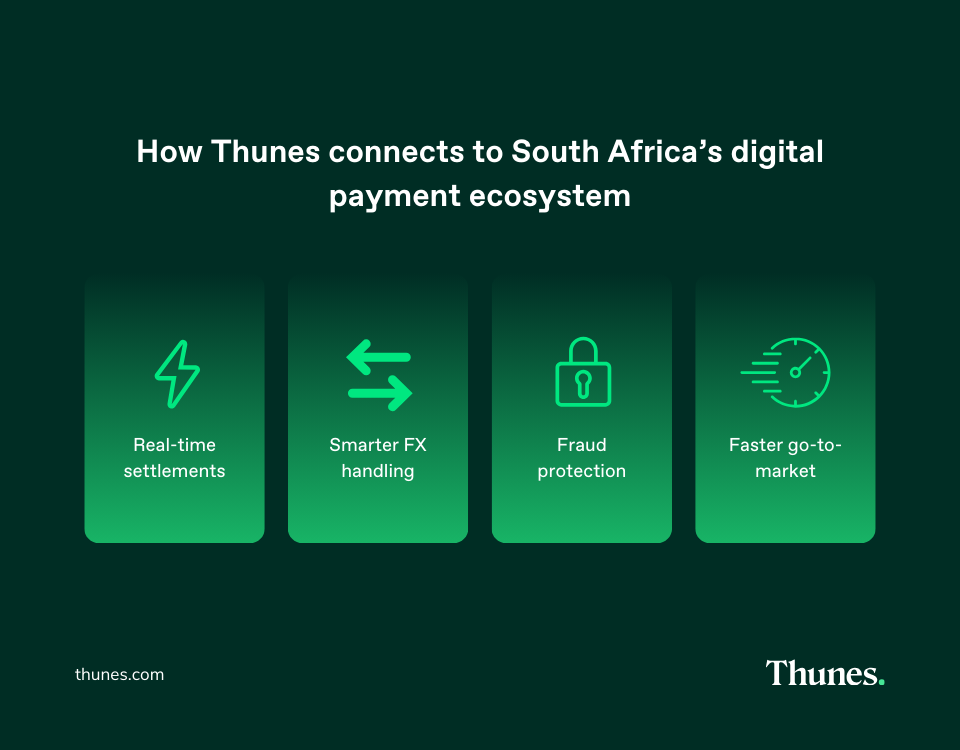
Connecting to South Africa’s evolving payments ecosystem, one integration at a time, is challenging because each digital wallet, bank, and payment rail has its own formats, requirements, and risk controls.
Thunes reduces this complexity through a single API connection.
Real-time connectivity across wallets, banks, and PayShap
With Thunes’ Direct Global Network, global businesses can send real-time payouts to local wallets and bank accounts and make collections using preferred domestic methods all through a single API.
That means there’s no need to maintain separate integrations. Partners plug in once and gain broad coverage across the South African market.
Smarter FX conversion and settlement
For cross-border flows, Foreign Exchange (FX) and reconciliation can be as challenging as the payments themselves. Thunes provides FX rates with transparent pricing and consolidated reporting across multiple payment methods and rails.
This streamlined settlement reduces operational overhead and allows payment and finance teams to support new corridors with more confidence.
Fraud protection
The shift to real-time and digital payments has driven double-digit year-on-year growth in fraud losses.
Greater visibility helps reduce fraud exposure without slowing payouts. Thunes embeds network-level fraud monitoring and transaction screening at every stage of the payment process, applying controls across wallets, banks, and PayShap.
Businesses can scale volumes with confidence while keeping operational complexity in check.
Faster go-to-market
Building direct local connectivity needs time, relationships, and technical resources. Thunes shortens that path, managing connections to local wallets, PayShap, and bank accounts, and handling local requirements and ongoing scheme changes.
With all this backend handled, global businesses can launch, test, and scale their South African offering more quickly.
Use cases enabled by Thunes
Through Thunes, companies can reach new customers and users across a range of sectors and industries:
- Collect cross-border e-commerce payments using local banks
- Pay gig workers, drivers, and freelancers directly into their preferred wallet, bank or stablecoin wallet
- Route remittances into mobile wallets so recipients can access funds instantly
- Pay suppliers and vendors through low-cost account-to-account transfers
Our single API lets businesses connect once, access multiple endpoints, and rely on a network already tuned to local conditions.
Connect to digital payments in South Africa
In South Africa, digital payments will play a larger role in financial inclusion and ecommerce. As mobile wallets and super app-style platforms continue to develop, they will likely become the primary entry point for everyday financial activity, from transport and shopping to savings and credit.
For global businesses, the takeaway is clear. To stay competitive, you need flexible, multi-rail connectivity that treats digital payments in South Africa as a primary payment method, not an afterthought.
Want to reach more customers, increase conversion, and deliver instant money movement to and from South Africa? Contact us today.