Global Cross-Border Payments & Real-Time Solutions

Global real-time payments are revolutionizing financial transactions by providing faster, more efficient solutions.
This technology enhances customer experience, streamlines cash flow management, and reduces transaction costs. The increasing demand for instant payments is positioning real-time payment systems as a crucial part of the global financial infrastructure.
Thunes offers a comprehensive suite of services, enabling real-time payments across 130+ countries. Our platform allows businesses and consumers to send and receive payments via mobile wallets and bank accounts seamlessly.
In this article, we’ll explore the landscape, benefits, challenges, and future of real-time payments.
Table of Contents
What are Real-Time Payments (RTPs)?

In contrast to traditional payment methods, real-time payments are instant, available 24/7 and secure – enabling businesses to send and receive funds within seconds.
Japan’s Zengin System, originated in the 1970s, was the world’s first RTP system and focused on instant payments between consumers. With 21st-century technology, RTPs have become much more advanced. In 2008, the UK introduced its solution to RTPS – the Faster Payment Service. Eight years later, India rolled out its Unified Payments Interface (UPI). Eventually, the USA finally joined this venture, offering FedNow in 2023.
Platforms like Thunes have contributed to the growth and accessibility of real-time payments with our borderless payment network. Businesses and consumers can send instant electronic payments across over 130 countries.
With such significant leaps in RTP technology, we make secure, rapid, real-time payments possible for B2B, B2C, and peer-to-peer transactions.
The Global Adoption of Real-Time Payments

Real-time payment systems are evolving in countries seeking opportunities for economic growth and an alternative to paper-based payments.
Instant payment adoption is prevalent in North America, Europe, Asia-Pacific, Latin America, and Africa. These regions are integrating real-time payment systems into their existing banking infrastructure.
Let’s explore each in more detail.
North America
North America, particularly the United States, has picked up the pace of adopting RTP railways. As RTPs have no regulatory mandate in the US, market demand is the critical growth driver. While RTP railways were growing worldwide, this was different for the US. As a result, the country had to develop an RTP infrastructure and support instant transactions.
In response to market demand, the US introduced FedNow in 2023. FedNow has significantly impacted the US economy, enabling faster, more efficient transactions within the USA. Organisations and individuals can make instant electronic payments 24/7.
While the US leads the forefront of RTP railways in North America, Canada needs to catch up. The development of RTPs in Canada has been challenging. This infrastructure was to launch in 2019. After experiencing countless delays, it was postponed to 2026. RTPs in Canada have had a complex integration with the country’s existing financial infrastructure, causing these delays.
Europe
Unlike North America, Europe is among the leaders in RTP adoption. In November 2017, Europe introduced the Single Euro Payments Area (SEPA) Instant Credit Transfer scheme. This initiative facilitates euro-denominated instant payments. Service payment providers (PSPs) and banks can use this scheme across 36 EU countries. This payment railway is available 24/7, every day of the week, and supports transactions of up to €100,000.
In the UK, the Faster Payments Service (FPS) drives further innovation in the European RTP infrastructure. Participating consumers, businesses, and banks can send and receive electronic sterling payments. Funds settle and are available immediately. However, senders cannot cancel or recall transactions. FPS does not support cross-border RTP transactions. Yet, this development marks significant progress for global real-time payments.
Asia-Pacific
The Asia-Pacific region boasts dynamic advancements in real-time payments, with India as the global leader. RTPs in India are a familiar concept used among businesses, consumers, and peers. Consumers use India’s Unified Payments Interface (UPI) to buy items from street vendors, highlighting how common RTPs are in this country.
RTPs are also a popular payment method in China, fueled by the widespread adoption of digital wallets and mobile payments. The rapid digitalisation of the Chinese economy, the successful integration of RTPs in social networks and payment platforms, and substantial investments in mobile payment solutions have paved the way for tremendous growth in China’s instant payments.
Australia is another critical player in the adoption of RTPs in Asia-Pacific. The New Payments Platform (NPP) was launched in 2018. Over 100 banks, FinTechs, and building societies can leverage instant payments.
Latin America and Africa
Emerging markets within Latin America and Africa are recognising the value of real-time payments. As the third fastest-growing RTP market, Brazil unveiled its RTP system, Pix, in 2020. Pix is available to over 120 million users and 700 financial institutions. This railway is rapidly cutting into card and debit payments revenue as Pix is more convenient and cheaper. As a result, unbanked consumers find more value in its financial inclusion.
Africa is also contributing to the rise of global real-time payments. This region has long embraced money platforms for instant transactions. Like Brazil, Africa’s RTP systems address underbanked populations. West Africa, namely Nigeria, has been one of the top ten global RTP markets, offering its RTP system, NIBSS Instant Payments (NIP), since 2011.
South Africa was among the early adopters of instant transactions as Africa’s second-largest RTP market. In 2006, they introduced their RTP railway, Real-Time Clearing (RTC). In 2023, South Africa made another advancement in its RTP infrastructure through PayShap. This program supports lower instant transaction values with improved security and fraud control.
Challenges and Considerations of Global Payments
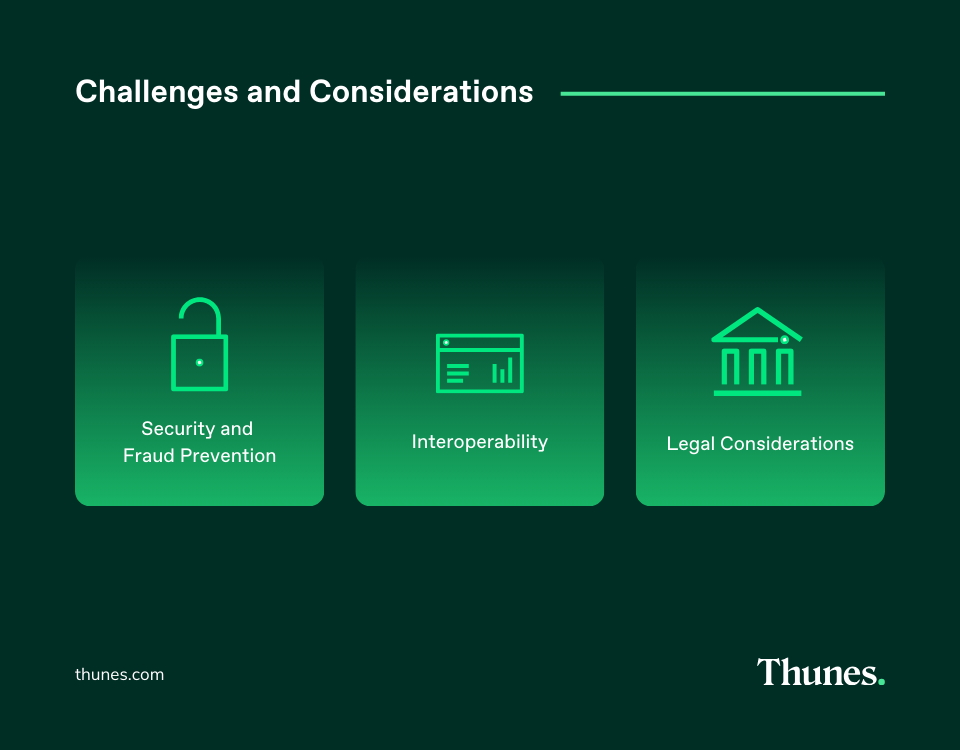
The increasing integration of real-time payment systems poses many challenges for financial institutions and payment service providers.
Organisations must deploy methods to monitor and reduce fraudulent transactions, and prioritise legal considerations for these digital payments. Countries also need to develop set standards and protocols to achieve interoperability.
Ensuring Security and Fraud Prevention
While instant transactions offer convenience, RTP transactions’ speed challenges security and fraud prevention.
With high volumes of payments settling instantly, detecting and stopping fraud is more complex. This challenge highlights the need for robust security measures. Banks should invest in advanced encryption, authentication protocols, and fraud detection mechanisms.
Banks must also adopt real-time monitoring systems to detect and mitigate fraudulent activities. By implementing AI, banks can improve the speed, precision, and patterns of anomaly detection and reduce false positives for fraud prevention.
Interoperability Across Networks
Interoperability refers to the seamless integration and communication between different RTP systems and payment networks. Achieving interoperability remains a significant challenge.
Various RTP systems have varying technologies, standards, and protocols. Cross-border payments need more standardisation between countries. This makes interoperability complex and threatens the global adoption of real-time payments.
With interoperability, customers and businesses can experience seamless real-time transactions regardless of the payment system or network they use. Banks must create standard messaging formats and protocols. They need to establish a standard identifier and have the assurance that transactions can be communicated smoothly.
Legal Considerations for Cross-Border Transactions
Customer protection is the most critical legal consideration for RTPs. Consumers have different levels of power than financial institutions and service providers. Countries must prioritise regulations and business conduct rules to ensure consumers are fairly treated. Financial organisations must take responsibility for managing and processing RTPs.
However, maintaining customer protection is challenging in various regions. Each has varying regulations and standards, making compliance complex for global payment providers. Payment service providers must stay informed about local regulatory requirements, ensure compliance to avoid legal repercussions and maintain trust in RTP systems.
Key Benefits of Instant Payments

Real-time payments worldwide have brought significant advantages to both consumers and businesses. Organisations can improve customer experience as funds are received and sent to every customer’s bank account instantly.
They can also make strategic decisions quicker through enhanced cash flow management and reduce costs, as real-time payments don’t incur hefty expenses like legacy payments.
Enhanced Customer Experience
Real-time payments deliver improved customer experience by enabling instant fund transfers. This reduces waiting times and offers greater convenience. This immediacy enhances satisfaction and loyalty for both consumers and businesses. At Thunes, our services contribute to fast and reliable transactions. We help companies to improve the overall customer experience.
Enhanced customer experience also increases user adoption. When RTP systems are easy to access, users are more likely to use them, driving global real-time payments.
Optimizing Cash Flow with Instant Payments
Real-time payments improve businesses’ cash flow management by allowing them to receive payments instantly. Organisations can improve liquidity management, reduce reliance on credit, and do more accurate financial planning. As RTPs have no settlement time, businesses can make informed strategic financial decisions and respond to economic changes more in real-time.
At Thunes, we provide robust payment solutions to help businesses maintain healthy cash flow and operate more efficiently. These solutions include sending and receiving funds directly between accounts and mobile wallets. We give organisations access to real-time payments regardless of the method.
Cost Efficiency
Real-time payments reduce costs associated with traditional payment methods, such as cheque processing and manual reconciliation. Unlike legacy solutions, RTPs have fixed fees per transaction. Because instant payments are faster, this minimises delays. This means organisations have greater operational efficiency and cost savings.
Integrating Thunes’ real-time payment network allows businesses to minimise transaction costs. There are no lengthy settlement times or fees, and there are no costs to third-party networks to process transactions.
The Future of Instant Payments
Real-time payment applications have expanded beyond traditional banking into sectors such as retail, healthcare, and government services. Government agencies can provide immediate tax returns, businesses can distribute salaries immediately, and customers can settle healthcare bills with minimal effort.
These use cases favour consumers and organisations, driving the revolution in international transactions. As cross-border payments offer critical advantages such as speed, cost-effectiveness, and transparency, this will accelerate instant transactions across the globe.
Organisations can settle supplier payments and extend their services to customers worldwide as they have the infrastructure to receive these transactions instantly.
To gain more insights into the future of global real-time payments, check out our eBook, “A New State of Play: Real-time Payments in 2024“.
Unlock Effortless Payments with Thunes
While RTP networks are powerful domestically, in most instances, there is no easy way to send a payment from one national network to another.
These schemes have been developed with a domestic mindset, and international settlement remains challenging.
Thunes can help. Our proprietary direct network enables members to access interoperability to most RPP networks worldwide with a single API connection. Our network provides access to 320+ payment methods, 130+ countries and over 80+ currencies, as well as payments to over 7 billion mobile wallets and bank accounts. Additionally, we offer transparency, pricing, and speed to make cross-border transactions feel more like domestic RTP networks.
We’re constantly adding new partners and payment methods to scale, adjust and customise RTP solutions. We’ll take care of the network or operational management so you can focus on scaling your business to realise the benefits of cheaper, speedier and more secure transactions.
Contact Thunes to learn more about our instant payments, or explore our Pay and Accept network capabilities today.