How to Navigate Cross-Border Payments Compliance

Modern payment technologies have made the global economy more connected than ever. Yet, while global expansion creates opportunities, it also introduces new layers of complexity.
For businesses, enterprises, marketplaces and creator platforms, the ability to make cross-border payments that comply with application regulations is essential to operational success. Failure to meet regulatory standards can result in fines, penalties, loss of business, and reputational damage.
Let’s explore why payments have become so complex, as well as the key challenges and best practices. We’ll also look at how Thunes, the Smart Superhighway to move money around the world, can help you make global payments that are safe, secure and instant.
Looking for a payment network that will help you reach more countries without complications? Learn about Thunes’ payment solutions.
Table of Contents
The growing complexity of cross-border payments
Businesses and platforms can make payments to more markets in more countries than ever before. Yet, these international transactions are far from straightforward.
Several factors cause the complexity:
- Multiple local regulations, sometimes divergent: Each country has its own central banks and financial institutions that govern cross-border payouts, tax laws, and anti-money laundering standards. In some instances, they require businesses to set up local entities and bank accounts, which is complex and costly.
- Outdated infrastructure: Legacy technology can leave businesses struggling to process and monitor payments. This means much of the handling and verification has to be done manually.
- Fragmented payment chains: Making payments to other countries means they have to travel through fragmented payment chains and several third parties, which can add layers of cost, processing time, and regulations.
- Evolving fraud tactics: Fraud is on the rise and becoming increasingly sophisticated. Businesses and platforms must find ways to spot potential issues and red flags, monitor vast data, and streamline the reporting process.
These layers can make cross-border payments challenging and leave businesses vulnerable to making mistakes with compliance.
What are the key cross-border regulatory requirements?
The key to compliance is understanding the frameworks each country enforces, and the compliance procedures businesses must follow to meet them.
To simplify this, the main cross-border regulatory requirements can be grouped into a few core categories.
| Category | Examples of Global/Regional Frameworks | Business impact |
| AML/TF and KYC | FATF Recommendations, EU AMLD6, US Bank Secrecy Act | Requires customer due diligence, transaction monitoring, and suspicious activity reporting |
| Data protection | GDPR (EU/UK), PIPL (China), LGPD (Brazil), EU–US Data Privacy Framework | Controls on personal data use, storage, and transfer across borders |
| Payment regulations | PSD2 (EU), Dodd-Frank (US), Payment Systems Act (Singapore), PIX regulation (Brazil) | Mandates secure payments, open banking standards, and fraud prevention |
| Sanctions and PEP screening | OFAC (US), EU sanctions lists, UN Sanctions Committees | Obligates the screening of counterparties against global sanctions lists |
| Local licensing requirements | MAS (Singapore), FCA (UK), ACPR (France), Central Bank of Kenya | Often requires regulated payment partners and compliance with local regulations |
Let’s look at these in more detail.
Understanding country-specific frameworks
Each country and region has its own regulatory frameworks and compliance rules that must be followed when making payments that cross its borders. Some examples include:
- European Union: Payment Services Directive 2 (PSD2), General Data Protection Regulation (GDPR), and Strong Customer Authentication (SCA). The EU also enforces the Wire Transfer Regulation for payment traceability and the Digital Operational Resilience Act (DORA), which sets ICT and cybersecurity standards for financial services.
- United Kingdom: Dodd-Frank Act, Bank Secrecy Act (BSA), Electronic Funds Transfer Act (EFTA), with oversight from the CFPB and OCC. The Electronic Money Regulations (EMRs) and Payment Services Regulations (PSRs) govern how e-money and payment institutions operate, aligning UK requirements with broader European frameworks.
- Asia-Pacific: Payment Services Act (Singapore), ASEAN Payment Connectivity, and APEC Cross-Border Privacy Rules (CBPR).
- Latin America: Brazil’s Payment Systems Act, Mexico’s AML Law, and regional initiatives to strengthen digital commerce.
- Africa: Many countries are governed by their respective Payment System Management Acts, while the Pan-African Payment and Settlement System (PAPSS) plays a crucial role in facilitating cross-border payments
Anti-Money Laundering/Terrorist Financing (and Know Your Customer)
Anti-Money Laundering/Terrorist Financing (AML/TF) compliance is another set of regulations businesses and platforms must follow when making global payments. Procedures must be in place to identify customers, monitor transactions, and follow international standards.
Part of this is Know Your Customer (KYC) procedures, which allow assessing the customer risk. They are a legal requirement to comply with Anti-Money Laundering laws. Robust KYC processes are essential for a financial institution to verify customer identity, determine the nature of the customer’s activity, and assess whether there are reasons to be concerned about money laundering or terrorism financing.
Ensuring data security and protection
Almost all countries have some form of data protection regulations that must be adhered to when making payments within their economies. Businesses and platforms must understand what these rules are, where and how they apply.
- GDPR in the EU and UK mandates strict controls on personal data use and transfer.
- The EU–US Data Privacy Framework (2023) established clearer rules for transatlantic data transfers.
- China’s Personal Information Protection Law (PIPL) restricts how companies handle data of Chinese citizens.
- Brazil’s LGPD mirrors GDPR principles for Latin American markets.
The penalties for mishandling this data can be severe. That’s why robust data security practices must be implemented in any business that makes cross-border payments.
Using the right payment methods
Not every payment method works in every country. Some countries have moved toward mobile and digital wallets, while others still depend on bank accounts and card payments.
Knowing which payment options to offer and the regulations needed to make these transactions securely is key.
What are the best practices to improve compliance?
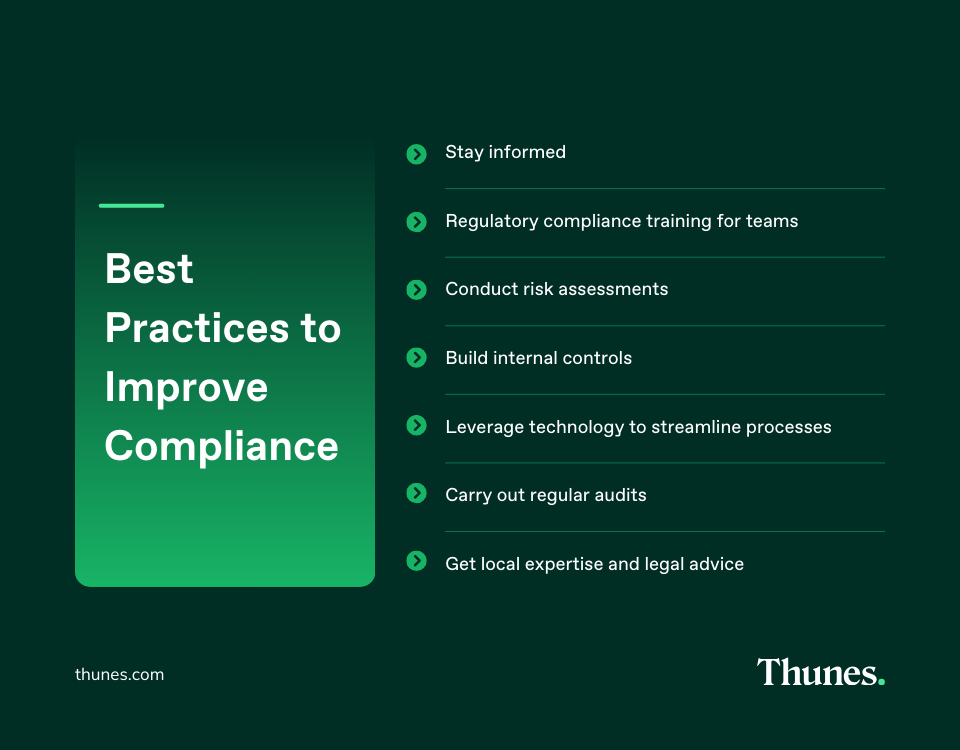
Businesses and platforms can take several steps to ensure payments meet regulatory requirements and create a culture prioritising compliance.
Stay informed
Regulations and compliance rules are constantly evolving. What was standard practice yesterday might not be the same tomorrow. Businesses and platforms need to stay updated on the latest developments and understand how regulatory requirements may affect their operations.
Regulatory compliance training for teams
Training programmes keep teams that handle transactions aware of any regulations or compliance requirements they may encounter when processing payments. It also helps build a culture that values compliance.
Conduct risk assessments
Before expanding your payment capabilities to other markets and countries, start with a comprehensive risk assessment. It’s critical to identify potential risks associated with cross-border transactions and develop a strategy to mitigate them should they occur.
Build internal controls
Implement structured compliance procedures and internal control processes, such as vendor vetting, automated transaction screening, and tiered payment authorisation, to safeguard against errors and financial crime.
Leverage technology to streamline processes
Businesses can use compliance software to help automate the onboarding of new payment technology, payment screening, AML/TF compliance and transaction monitoring. It can also improve data storage and streamline reporting, which improves the KYC & AML/TF process.
Carry out regular audits
It’s difficult to know if the payments you process meet compliance requirements if you don’t audit them. Regular internal and external audits can help to spotlight potential weaknesses in your compliance processes, enabling you to fix them before they cause serious issues.
Get local expertise and legal advice
Before moving into new markets or expanding into regions where you make payments, you need to understand the popular payment methods and ensure they are fully compliant. Consulting with local experts or seeking legal advice beforehand gives vital insight into the procedures and processes of that country.
Benefits of partnering with a payments partner like Thunes
Adhering to the complex web of compliance and regulatory frameworks requires expertise and resources, which many businesses and platforms lack.
Working with a regulated payment platform like Thunes ensures compliance while delivering swift and secure cross-border payments. Our regulated Direct Global Network supports compliance standards worldwide, including:
- The UK: Thunes is an Authorised Payment Institution by the UK’s Financial Conduct Authority.
- France: The French Prudential Supervisory Authority – Autorité de Contrôle Prudentiel et de Résolution (ACPR) – issues our Payment Institution License.
- The EU: We have the EU extension of the France licence, confirming our compliance with transactions in and out of the EU
- The USA: Thunes is registered as a Money Service Business with FinCen and Money Transmitter.
- Singapore: The Monetary Authority of Singapore issued Thunes as a Major Payment Institution.
- Hong Kong: Thunes has a Money Service Operator License issued by the Hong Kong Customs and Excise Department.
These standards fall under our Fortress Compliance Platform, where we deliver proprietary systems, licenses, relationships, processes, controls, and vast expertise. We offer industry-leading compliance solutions, including transaction monitoring, smart screening, dynamic scoring and more, to ensure safer transactions.
With a single API connection to Thunes, businesses, platforms, marketplaces, and ecommerce merchants can settle their payments in 130 countries and in 80 currencies with real-time settlements and transparent FX – all without setting up a local entity or bank account.

Simplify cross-border payments compliance with Thunes
Meeting regulatory frameworks and compliance rules can’t be an afterthought. The stakes are too high. Ensuring your cross-border payments adhere to them is essential when making international payments and payouts.
By combining global reach with strong compliance infrastructure, Thunes enables businesses to grow with confidence in even the most complex markets. With one connection, enterprises can reach partners, suppliers, and customers across multiple markets, offer them preferred local payment methods including mobile wallets, bank accounts and card payments, and remain fully compliant.
We’re always working to fortify our compliance platform and expand our licences and payment capabilities far and wide. By integrating with our Direct Global Network, no market or demographic is out of reach.
Elevate your payment solutions with Thunes, the Smart Superhighway to move money around the world.