What Are Real-Time Payments? Worldwide Statistics

Real-time payments (RTPs) allow for the immediate transfer of funds 24/7 – and they are redefining traditional banking norms.
Instant payments allow businesses, banks and other financial institutions to deliver a more seamless customer experience, while optimising cash flow management and business processes.
The expansion of real-time payments has opened numerous opportunities for companies that need to operate cross-border payments and Thunes is the perfect partner for these businesses. We offer an extensive network of direct connections, allowing us to offer speedy payments. Businesses and individuals can send and receive instant payments to mobile wallets and their bank accounts regardless of what RTP network they use.
Several countries dominate the RTP market and pave the way for instant payment innovations. This article will explore real-time payments and the countries with the highest RTP markets worldwide.

Table of Contents
Key Statistics
- The Real-Time Payments Market size reached $25.92 billion in 2024. It will grow to $116.23 billion by 2029. [1]
- Between 2024 and 2029, the RTP market is growing at a CAGR of 35%. [1]
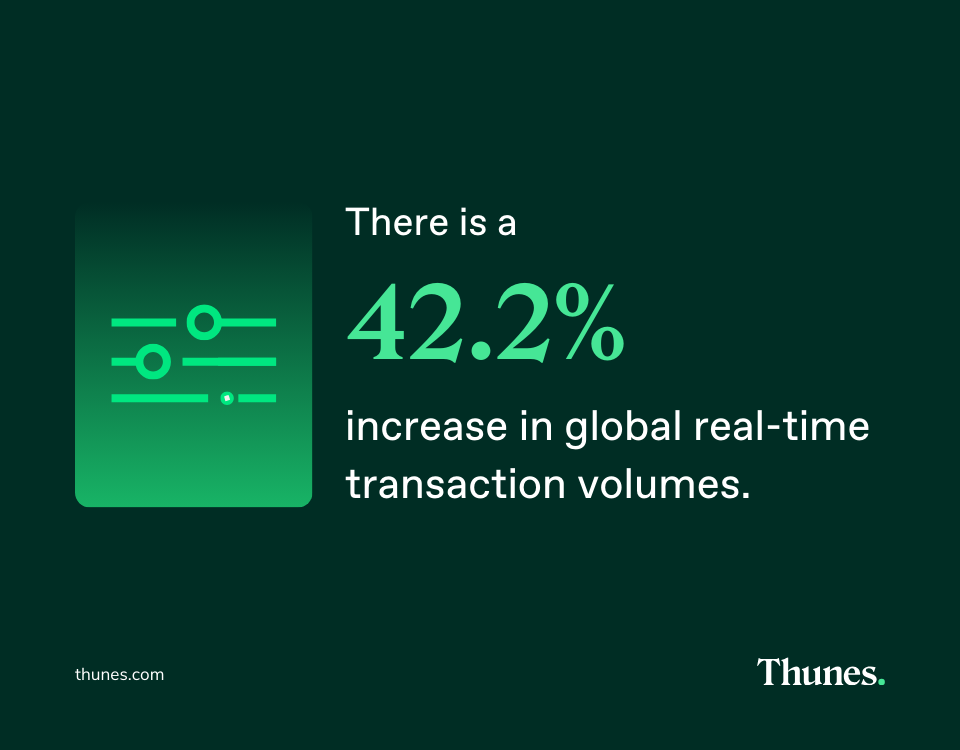
- There is a 42.2% increase in global real-time transaction volumes. [2]
- 84% of all India’s electronic payments are in real-time. [2]
- India, Brazil, Indonesia, Malaysia, and the Netherlands are five of the world’s most successful real-time payment markets. [3]
- Brazil will have over 115,000 million RTP transactions by 2028, at a CAGR of 25.4%. [7]
- Indonesia’s real-time payments market growth has a CAGR of 81.9% between 2022 and 2027. [11]
- RTPs in Malaysia were worth $1.9 billion in 2023. [14]
- RTPs in the Netherlands have a YoY growth rate of 32% between 2022 and 2023. [18]
- The Real-Time Payments market size is forecast to increase by $112.32 billion in 2028. [19]
What are Real-Time Payments?

Real-time payments are payments that are initiated and settled instantaneously. Unlike traditional payment methods, these immediate payments are available 24/7.
Real-time payment systems are available for domestic and international transactions. For example, Thunes provides pay-to-wallet and pay-to-bank options that allow customers and businesses worldwide to initiate instant transactions to mobile wallets and recipient accounts.
Real-time payments have existed for some time. However, these payment railways have become popular among financial institutions, businesses, and customers. In 2024, the RTP market was worth $25.92 billion. It is expected to reach $116.23 billion by 2029 at a compound annual growth rate (CAGR) of 35%.
Where are Real-Time Payments Available?

At Thunes, we have helped countless businesses leverage real-time payment infrastructures worldwide with our RTP network. In fact, global real-time transaction volumes increased by 42.2% as of 2024.
But, a handful of countries drive this rapid adoption of real-time payments, boasting the top RTP markets globally. According to the Prime Time for Real-Time Global Payments report by ACI Worldwide, the countries with the top RTP market sizes include:
- India
- Brazil
- Indonesia
- Malaysia
- The Netherlands
In addition, this ACI Worldwide report outlines the primary factors influencing how quickly a country adopts real-time digital payments:
- Active Collaboration: Government agencies, financial institutions, central banks, and payment service providers must collaborate to establish an RTP network. These parties must create a well-operating RTP ecosystem through clear communication and interoperability.
- Strong Merchant Incentives: Introducing instant payments relies on merchant adoption. Countries must incentivise merchants to join RTP networks and simplify onboarding.
- Cross-Border Ambition: Countries such as India that can send and receive payments worldwide will find it easier and quicker to build thriving RTP infrastructures.
- Open and Inclusive Payment Ecosystems: Regions with many FinTechs and small banks are more likely to establish an RTP network faster than large banks that have to reevaluate their frameworks to support instant payments.
- Constant Flow of Use Cases: To drive instant payments, countries must deliver innovative use cases for RTPs that enhance and simplify day-to-day consumer transactions and business operations.
The Top 5 Countries with the Highest Real-Time Payments Worldwide

India, Brazil, Indonesia, Malaysia, and the Netherlands are the top five countries with the highest real-time payment markets worldwide. However, these networks are not interoperable. This means that Brazilian users can’t send RTPs directly to Indian users through India’s RTP network because it is unavailable in Brazil.
Fortunately, Thunes solves this challenge for businesses and users, making these networks interoperable. Our platform enables cross-border RTPs between otherwise incompatible payment schemes. For example, users on Brazil’s RTP network can send transactions to users on India’s RTP network despite Brazilian senders not being a part of India’s RTP network
With that said, let’s take a closer look at these countries with the highest RTP transactions globally.
Real-Time Payments in India
India’s real-time payment system began with the launch of Immediate Payment Service in 2010. Six years later, in April 2016, the NPCI introduced the Unified Payments Interface (UPI). Today, India is the leading RTP market in the world.
Between 2023 and 2028, India’s RTP market will grow at a CAGR of 13.9%, and this region’s YoY growth is staggering at 44.6%. Research by ACI Worldwide confirms that India had 129.3 billion real-time transactions in 2023, almost half the global total﹣up by 45% from 2022. This report also indicates that 84% of transactions in India are now instant payments.
Consumers in India can make instant payments to peers and send money directly to a merchant’s bank account. They can make real-time payment transactions to settle bill accounts. All banks in this country have the infrastructure to support faster payments.
Real-Time Payments in Brazil
In 2020, Brazil’s Central Bank launched Pix, a digital, instant payment system created by the Central Bank of Brazil, which regulates banking in the country. Pix’s immediate payment service is free for consumers and inexpensive for businesses, driving this RTP network’s popularity. Users can send and receive payments 24/7. This platform has built-in authentication and encryption security features to mitigate fraudulent activity.
Based on research from Statista, instant payments made up 36.5% of all transactions in Brazil. This figure will increase, and Brazil’s RTP market will have 115,000 million RTP transactions by 2028, at a CAGR of 25.4%.
ACI Worldwide confirms that 77% of Brazilian consumers use Pix. This RTP system has a YoY growth rate of 77.9% between 2022 and 2023. Brazil’s RTP growth ranks it the second-largest RTP market size globally.
Real-Time Payments in Indonesia
Indonesia’s central bank launched its RTP system, BI-FAST, in December 2021. In contrast to other mobile banking services, BI-FAST has a proxy address feature. This feature allows customers to send or receive money using only their email addresses. Like Thunes, they can receive funds in their mobile wallets.
BI-FAST has grown tremendously in Indonesia because it offers:
- 24/7 real-time credit transfers. Customers and banks can receive faster payments with immediate settlements.
- Unique identifiers (proxy addresses) that simplify, secure, and facilitate instant payments.
- Integrated real-time fraud detection to mitigate data breaches and ensure faster payments reach the correct recipient.
As Finextra confirms, RTPs have gained considerable traction in Indonesia. Over half (55%) of the country’s consumers regularly use these payments. ACI Worldwide reveals that Indonesia’s real-time payments network is growing at a CAGR of 81.9% between 2022 and 2027. At the same time, RTPs was worth $1.9 billion in 2023, but this payment system had a YoY growth rate of 267% between 2022 and 2023.
Real-Time Payments in Malaysia
In 2018, PayNet, Malaysia’s national payments network and central infrastructure provider, introduced DutiNow, marking the further development of RTP networks in this region. In the year before, 2017, Bank Negara Malaysia (BNM) merged the payment companies MyClear and MEPS to form PayNet. PayNet is Malaysia’s first actual real-time payment network.
Becoming Malaysia’s core payments infrastructure, PayNet transactions were worth $1.9 billion in 2023, growing at a 26% YoY rate between 2022 and 2023. Between 2023 and 2028, RTPs in Malaysia will have a CAGR of 16.9%, reaching a market size of $4.1 billion by 2028.
As another testament to the rapid growth of RTPs in Malaysia, by 2022, only five years after establishing PayNet, RTPs already had the most significant market share compared to other e-commerce transactions.
Real-Time Payments in the Netherlands
The online banking e-payment initiative iDEAL was launched in 2005, making the Netherlands one of the early adopters of instant payments. This RTP network offered 24/7 instant payments to beneficiaries. However, the Netherlands introduced Dutch PSPs in 2019 to further modernise its instant payment infrastructure.
Dutch PSPs took consumers and businesses by storm. The transaction volume for this RTP network has more than doubled since iDeal in 2005, yet processing fees have only increased by 5%.
Today, immediate payments in the Netherlands make up 10.9% of the total payment volume, surpassing paper-based transactions. In 2023, RTPs in the Netherlands were worth over $1.3 billion, growing at a YoY rate of 32% between 2022 and 2023. Between 2023 and 2028, RTPs will have a CAGR of 25.8%, reaching a market share worth $10.109 trillion by the end of 2028.
Future Market Forecast of Real-Time Payments Globally

The forecasted growth of RTPs in India, Brazil, Indonesia, Malaysia, and the Netherlands signifies how these infrastructures will expand worldwide. Between 2023 and 2028, instant payments will increase to a market size of $112.32 billion at a CAGR of 40.94%.
The global RTP market has a YoY growth rate of 31.94% between 2023 and 2024 alone. Asia-Pacific will contribute 46% to the advancement of the worldwide market share during this forecast period.
Several factors drive this exponential growth of RTPs:
- The increasing adoption of smartphones
- Access to high-speed internet
- Improved cash flow management for businesses
- Reduced transaction costs
- More excellent fraud prevention, risk management, and payment visibility
Instant cross-border payment platforms like Thunes are also critical drivers in RTP adoption. We allow businesses and customers to send payments anywhere and exchange currencies at the market FX rates, making RTPs more accessible.
Our platform enables interoperability in the top RTP networks in these countries. Users can initiate instant transactions to bank accounts or digital wallets in all regions of the world.
Real-Time Payments for Domestic and International Transactions with Thunes
Real-time payments are growing in popularity worldwide, with India, Brazil, Indonesia, Malaysia, and the Netherlands at the forefront of this expansion. However, these networks lack interoperability, and Pix users can’t send RTPs to Indian users on UPI.
Thunes is the ultimate solution to this challenge. With our worldwide RTP network, organisations and financial institutions can enable cross-border payments to anywhere in the world.
Contact Thunes and find out how we can help you receive and send immediate payments.